
Table of Contents
The Kerala SET English Syllabus 2026 PDF has been officially prescribed by the LBS Centre for Science and Technology for candidates aspiring to qualify the Kerala State Eligibility Test (Kerala SET 2026). The syllabus covers the complete history of English literature, literary criticism, linguistics, English language teaching (ELT), British, American, Indian and Commonwealth literature, making it essential for candidates to have a proper preparation strategy.
Before starting your preparation, it is important to understand the latest Kerala SET English syllabus, exam pattern, and unit-wise topics to prioritise your study plan effectively. Download the Kerala SET English Syllabus 2026 PDF and get expert preparation tips to qualify the Kerala SET Exam in your next attempt.
Kerala SET English Syllabus 2026 Highlights
The Kerala SET English Exam 2026 evaluates candidates' knowledge of English Literature, Language, Literary Theory, Linguistics, and English Language Teaching. The official syllabus is divided into six major units comprising nearly 120 modules covering British Literature from Chaucer to Contemporary Literature, American Literature, Indian Writing in English, Literary Criticism, and Language Studies.
Check the important details related to the Kerala SET English Syllabus 2026 in the table below.
Particular | Details |
Exam Name | Kerala State Eligibility Test (Kerala SET) |
Subject | English |
Conducting Authority | LBS Centre for Science and Technology |
Kerala SET Exam Paper | Paper 2 (English) |
Kerala SET Exam Level | State Eligibility Test |
Kerala SET 2026 Exam Mode | Offline (OMR Based) |
Kerala SET English Syllabus 2026 Total Units | 6 |
Kerala SET English Syllabus 2026 Total Modules | 120 (Approx.) |
Official Kerala SET English Syllabus 2026 | Prescribed by LBS Centre |
Kerala SET Official Website |
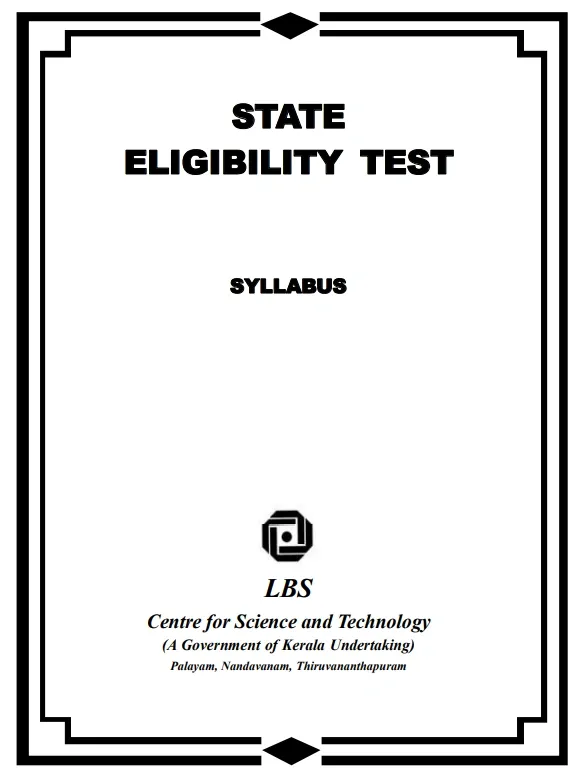
Kerala SET English Syllabus 2026 PDF Download
Candidates preparing for the Kerala SET Exam 2026 should always refer to the official Kerala SET English Syllabus PDF released by the LBS Centre for Science and Technology. The official syllabus helps aspirants understand every unit, module, and topic that may be covered in the exam, ensuring focused and effective preparation.
Click Here for Kerala SET English Syllabus 2026 PDF Download
Click Here for Kerala SET Paper 1 Syllabus PDF Download
Kerala SET English Syllabus 2026: Unit-wise Overview
The Kerala SET English Syllabus 2026 is divided into six units, covering the evolution of English Literature, Language Studies, Literary Theory, Linguistics, English Language Teaching, and World Literature. Each unit focuses on different literary periods, major authors, critical theories, and language concepts that are frequently tested in the Kerala SET exam 2026.
Kerala SET English Syllabus 2026 Units | Kerala SET English Syllabus 2026 Topics Covered |
Unit 1 | History of English Literature (Chaucer to the Neo-Classical Age) |
Unit 2 | Romantic and Victorian Literature |
Unit 3 | Twentieth Century & Contemporary British Literature |
Unit 4 | American Literature, Indian Writing in English & New Literatures |
Unit 5 | History of English Language, Linguistics & English Language Teaching (ELT) |
Unit 6 | Literary Theory, Literary Criticism & Cultural Studies |
The detailed unit-wise Kerala SET English syllabus 2026 is provided below to help candidates understand the important topics and plan their preparation systematically.
Kerala SET English Syllabus 2026: Unit 1 – History of English Literature (Chaucer to the Neo-Classical Age)
Kerala SET English Syllabus 2026 unit 1 introduces candidates to the evolution of English Literature from the Medieval Period to the Neo-Classical Age. This unit covers the literary movements, major writers, poetry, prose, drama, and socio-political developments that shaped English literary history. Candidates should focus on understanding literary periods, influential authors, and important literary works, as questions are frequently asked from these topics in the Kerala SET English exam 2026.
Module | Topics Covered |
Module 1 | Chaucer's Age – Socio-political background, Geoffrey Chaucer, William Langland, John Gower, General Prologue to The Canterbury Tales |
Module 2 | Early Renaissance in England – William Caxton, Thomas Malory, Songs and Ballads, Thomas More's Utopia |
Module 3 | Late Renaissance England – Wyatt and Surrey, Beginning of the English Sonnet, Edmund Spenser, Prothalamion, Spenserian Sonnet |
Module 4 | Beginning of English Prose – Sir Philip Sidney, Apology for Poetry, Francis Bacon, Thomas Hobbes, Thomas Browne, University Wits |
Module 5 | Rise of English Drama – Mystery Plays, Miracle Plays, Morality Plays, Interludes, Gorboduc, Ralph Roister Doister |
Module 6 | Revenge Tragedy – Thomas Kyd, Christopher Marlowe, Doctor Faustus, Blank Verse, John Webster, Ben Jonson, Comedy of Humours |
Module 7 | Elizabethan Theatre – Stage, Audience, Patronage, London Theatres, Stage Conventions, Soliloquy, Aside, Masque |
Module 8 | William Shakespeare – Comedies, Tragedies, Histories, Problem Plays, Sources of Shakespeare's Plays |
Module 9 | Shakespeare – Language, Folio, Quarto, Shakespearean Sonnets |
Module 10 | Metaphysical Poetry – John Donne (The Canonization), George Herbert, Henry Vaughan, Andrew Marvell, Metaphysical Conceit |
Module 11 | Puritan England – Reformation, Oliver Cromwell, Commonwealth, John Bunyan, Pilgrim's Progress |
Module 12 | John Milton – Paradise Lost (Book I), Lycidas, Sonnets, Prose, Pamphlets |
Module 13 | The Restoration – Restoration Drama, Comedy of Manners, William Congreve, William Wycherley |
Module 14 | Neo-Classical Age – Literary Features and Socio-political Background |
Module 15 | Heroic Drama, Anti-Sentimental Comedy, Richard Sheridan, Oliver Goldsmith |
Module 16 | Popular Prose Writing – Samuel Pepys, Periodical Essays, Joseph Addison, Richard Steele, Tatler, Spectator, Coffee Houses and Clubs |
Module 17 | John Dryden and Alexander Pope – Mock Heroic, Mock Epic, Mac Flecknoe |
Module 18 | Dr. Samuel Johnson, Jonathan Swift, Edmund Burke, John Locke |
Module 19 | Rise of the Novel – Daniel Defoe, Samuel Richardson, Epistolary Novel, Tobias Smollett, Henry Fielding, Picaresque Novel, Laurence Sterne |
Module 20 | Transition Poetry – Thomas Gray, Elegy Written in a Country Churchyard, William Collins, William Cowper, Robert Burns, William Blake |
Kerala SET English Syllabus 2026: Unit 2 – Romantic & Victorian Literature
Kerala SET English Syllabus 2026 Unit II focuses on the Romantic Age and the Victorian Period, two of the most significant eras in English Literature. The syllabus covers Romantic poetry, Victorian fiction, prose, drama, feminism, industrialisation, realism, and literary criticism. Candidates preparing for the Kerala SET English Exam 2026 should pay special attention to major poets, novelists, literary movements, and social reforms of this period.
Module | Topics Covered |
Module 1 | Beginning of Romanticism – Percy's Reliques, French Revolution, Return to Nature, Subjectivity, Language |
Module 2 | Wordsworth's Preface to Lyrical Ballads |
Module 3 | Early Romantics – William Wordsworth, Samuel Taylor Coleridge, Lyric, Ode |
Module 4 | Later Romantics – Lord Byron, P.B. Shelley, John Keats |
Module 5 | Gothic Novel – Mary Shelley, Horace Walpole |
Module 6 | Historical Novel – Walter Scott, Domestic Novel, Jane Austen |
Module 7 | Romantic Prose – Charles Lamb, William Hazlitt, Leigh Hunt, Thomas De Quincey |
Module 8 | Early Feminist Writing – J.S. Mill (The Subjection of Women), Mary Wollstonecraft (A Vindication of the Rights of Woman) |
Module 9 | Beginning of the Victorian Age – Socio-political Background, Victorian Compromise |
Module 10 | Victorian Poetry – Alfred Tennyson, Dramatic Monologue, Robert Browning, Matthew Arnold |
Module 11 | Pre-Raphaelite Movement – D.G. Rossetti, A.C. Swinburne, William Morris |
Module 12 | Aestheticism – Walter Pater, Art for Art's Sake |
Module 13 | Victorian Prose – Thomas Carlyle, Matthew Arnold, Cardinal Newman, Religious Prose |
Module 14 | Victorian Biography and Autobiography – John Ruskin, Lytton Strachey, Leslie Stephen |
Module 15 | Victorian Novel – Reform Acts, Industrialisation, Charles Dickens |
Module 16 | Thomas Hardy – Wessex Novels |
Module 17 | Victorian Women Novelists – Brontë Sisters, George Eliot, Realistic Novels, William Makepeace Thackeray, George Meredith, R.L. Stevenson |
Module 18 | Victorian Drama – Comedy of Manners, Oscar Wilde, Discussion Plays, George Bernard Shaw |
Module 19 | Transition Poetry – Gerard Manley Hopkins, Inscape, Instress, Sprung Rhythm, The Windhover |
Module 20 | Victorian Age and Colonial Enterprise – Macaulay's Minute, Matthew Arnold, Culture and Anarchy, Rudyard Kipling |
Kerala SET English Syllabus 2026: Unit 3 – 20th Century & Contemporary British Literature
Kerala SET English Syllabus 2026 Unit 3 focuses on 20th Century and Contemporary British Literature, covering major literary movements, modern poetry, novels, drama, and post-war literature. Candidates should understand the historical background, literary trends, influential authors, and important critical concepts to score well in the Kerala SET exam 2026.
Module | Topics Covered |
Module 1 | Edwardian Period – World War I, Socio-political Background |
Module 2 | War Poets – Rupert Brooke, Wilfred Owen, Siegfried Sassoon |
Module 3 | Pink Poets – W.H. Auden, Cecil Day Lewis, Stephen Spender, Louis MacNeice |
Module 4 | Avant-garde Writing – Symbolist Movement, W.B. Yeats, Surrealism, Dylan Thomas |
Module 5 | Modernist Poetry – High Modernists, Ezra Pound, T.S. Eliot |
Module 6 | Verse Drama – Christopher Fry, T.S. Eliot |
Module 7 | World War II and its Aftermath – Movement Poetry, Philip Larkin, Thom Gunn |
Module 8 | Ted Hughes, Seamus Heaney, Andrew Motion |
Module 9 | Twentieth Century Prose – G.K. Chesterton, Max Beerbohm, Bertrand Russell |
Module 10 | Twentieth Century Novel – Virginia Woolf, Modern Fiction, Joseph Conrad |
Module 11 | Early Modernism – D.H. Lawrence, Psychological Novel |
Module 12 | Stream of Consciousness – James Joyce, Virginia Woolf |
Module 13 | Dystopian Literature – Aldous Huxley, George Orwell |
Module 14 | Post-war Fiction – William Golding, Kingsley Amis, John Wain, Allan Sillitoe |
Module 15 | Modern Drama – Henrik Ibsen and His Influence, George Bernard Shaw |
Module 16 | Irish Dramatic Movement – Abbey Theatre, Celtic Revival, W.B. Yeats, J.M. Synge, Sean O'Casey |
Module 17 | Post-war Drama – Kitchen Sink Drama, Arnold Wesker, Angry Young Men Movement, John Osborne |
Module 18 | Theatre of the Absurd – Samuel Beckett, Harold Pinter, Tom Stoppard, Epic Theatre, Edward Bond |
Module 19 | Recent Trends in British Writing – Doris Lessing, Iris Murdoch, Jeanette Winterson |
Module 20 | Immigrant Writing – Kazuo Ishiguro, Hanif Kureishi |
Kerala SET English Syllabus 2026: Unit 4 – American, Indian & New Literatures in English
Kerala SET English Syllabus 2026 Unit 4 covers American Literature, Indian Writing in English, African Literature, Caribbean Literature, Canadian Literature, Australian Literature, and South Asian Literature. This unit is particularly important as it introduces candidates to postcolonial perspectives, multicultural writing, and major literary figures from across the world.
Module | Topics Covered |
Module 1 | Pilgrim Fathers, Puritanism in America, American Romanticism, Emerson, Thoreau, Nathaniel Hawthorne |
Module 2 | Nineteenth & Twentieth Century American Poetry – Walt Whitman, Emily Dickinson, Edgar Allan Poe |
Module 3 | Robert Frost, Ezra Pound, E.E. Cummings, Wallace Stevens, Robert Lowell, Anne Sexton |
Module 4 | Nineteenth Century American Novel – Mark Twain, Herman Melville, Harriet Beecher Stowe, William Faulkner, Henry James |
Module 5 | Twentieth Century American Novel – Ernest Hemingway, John Steinbeck, Saul Bellow, Leslie Marmon Silko |
Module 6 | Harlem Renaissance & American Drama – Ralph Ellison, Alice Walker, Toni Morrison, Eugene O'Neill, Tennessee Williams, Arthur Miller, Lorraine Hansberry, Sam Shepard, Amiri Baraka |
Module 7 | Beginnings of Indian English Poetry – Michael Madhusudan Dutt, Sri Aurobindo, Rabindranath Tagore, Toru Dutt, Sarojini Naidu |
Module 8 | Modern Indian English Poetry – Nissim Ezekiel, Keki N. Daruwalla, A.K. Ramanujan, Jayanta Mahapatra, Kamala Das, Dom Moraes, Gieve Patel, Arun Kolatkar |
Module 9 | Early Indian English Novel – Raja Rao, R.K. Narayan, Mulk Raj Anand, Khushwant Singh |
Module 10 | Contemporary Indian English Novel – Nayantara Sahgal, Anita Desai, Shashi Deshpande, Salman Rushdie, Jhumpa Lahiri, Arundhati Roy |
Module 11 | Indian English Drama – Harindranath Chattopadhyay, T.P. Kailasam, Asif Currimbhoy, Badal Sircar, Girish Karnad, Manjula Padmanabhan |
Module 12 | African Literature & Colonialism – Léopold Sédar Senghor, Christopher Okigbo, Chinua Achebe, Wole Soyinka |
Module 13 | African Literature & Postcolonialism – Ngũgĩ wa Thiong'o, John Pepper Clark, Ben Okri, Athol Fugard |
Module 14 | Caribbean Intellectual Tradition – Aimé Césaire, Frantz Fanon, C.L.R. James |
Module 15 | Caribbean Literary Tradition – V.S. Naipaul, George Lamming, Derek Walcott, Edward Kamau Brathwaite |
Module 16 | Canadian Literature – Modernism, E.J. Pratt, Sinclair Ross, Tomson Highway, Margaret Laurence |
Module 17 | Contemporary Canadian Literature – Multiculturalism, Diaspora, Claire Harris, Rohinton Mistry, Joy Kogawa, Michael Ondaatje |
Module 18 | Australian Literary History – Bush Poetry, A.D. Hope, Judith Wright, Les Murray |
Module 19 | Modern Australian Literature – Patrick White, Sally Morgan, David Malouf, David Williamson |
Module 20 | South Asian Literature – Lakdasa Wikkramasinha, Romesh Gunesekera, Edwin Thumboo, Alamgir Hashmi, Maki Kureishi, Taslima Nasreen |
Kerala SET English Syllabus 2026: Unit 5 – History and Structure of English & English Language Teaching (ELT)
Kerala SET English Syllabus 2026 Unit 5 focuses on the history and evolution of the English language, linguistics, phonetics, morphology, semantics, and English Language Teaching (ELT). This unit also covers various language teaching methods, classroom practices, evaluation techniques, and language acquisition theories. Candidates preparing for the Kerala SET English Exam 2026 should develop a clear understanding of both theoretical concepts and practical aspects of English language teaching.
Module | Topics Covered |
Module 1 | Sound System of English – Vowels and Consonants |
Module 2 | English Phonology – Syllable Structure, Stress, Connected Speech, Intonation, Assimilation, Elision, Weak Forms |
Module 3 | English Morphology – Morphemes, Word Formation, Affixation |
Module 4 | Semantics – Types of Meaning, Semantic Change |
Module 5 | Indo-European Family of Languages – Origin of English, Germanic Family, Grimm's Law, Verner's Law |
Module 6 | Old English – Dialects, Grammar, Pronunciation, Vocabulary, Literature, Scandinavian Influence |
Module 7 | Middle English – Norman French Influence, Grammar, Pronunciation, Vocabulary, Literature, Bible Translations |
Module 8 | English at the Renaissance – Influence of Latin and Greek, Colonialism, Contributions of Shakespeare and Milton |
Module 9 | English Overseas – American English, Indian English, Pidgins and Creoles |
Module 10 | English in the Postcolonial World – English as a Global Language, World Englishes |
Module 11 | Approaches to Language Learning – Behaviourism, Cognitivism, Constructivism, Social Constructivism, Critical Pedagogy |
Module 12 | Theory of Language – Language as Knowledge, Skill, Structure and Behaviour |
Module 13 | History of English Language Teaching in India – Macaulay, English in Independent India, English as a Language of Opportunity |
Module 14 | ESL, EFL & ESP – English as a Second Language, Foreign Language and Specific Purposes |
Module 15 | Methods of Language Teaching – Grammar Translation, Direct Method, Audio-Lingual, Oral-Situational, Silent Way, Community Language Learning |
Module 16 | Learner Factors – Attitude, Aptitude, Motivation, Age, Learning Environment |
Module 17 | Classroom Procedures – Lesson Planning, Presentation, Interaction, Feedback, Evaluation, Teaching Prose, Poetry, Grammar and Communication Skills |
Module 18 | Teaching Materials – Traditional Teaching Aids, Audio-Visual Aids, Computer Assisted Language Learning (CALL) |
Module 19 | Tests and Evaluation – Formative & Summative Assessment, Continuous Evaluation, Types of Tests, Evaluation Tools |
Module 20 | Keywords – Bilingualism, Multilingualism, L1 & L2, Language Acquisition, Code Mixing, Code Switching, First Language Interference |
Kerala SET English Syllabus 2026: Unit 6 – Literary Theory & Criticism
Unit 6 is one of the most important sections of the Kerala SET English Syllabus 2026, covering Literary Theory, Literary Criticism, Cultural Studies, Feminism, Postcolonialism, Structuralism, Marxism, Psychoanalysis, Translation Studies, and Indian Aesthetics. Candidates should focus on understanding major critics, literary theories, philosophical concepts, and their practical applications in literary analysis.
Module | Topics Covered |
Module 1 | Aristotle – Poetics, Tragedy, Catharsis, Longinus, Sublime, Sidney's Apology for Poetry, Samuel Johnson's Preface to Shakespeare |
Module 2 | Romantic Criticism – Poetic Diction, Fancy & Imagination, Negative Capability |
Module 3 | Matthew Arnold – The Function of Criticism, T.S. Eliot, Tradition and the Individual Talent, Objective Correlative, F.R. Leavis, Practical Criticism |
Module 4 | William Empson, Ambiguity, Cleanth Brooks, The Language of Paradox, I.A. Richards, New Criticism, Northrop Frye, Archetypes |
Module 5 | Liberal Humanism, Turn to Theory, Text, Identity, Language, Russian Formalism |
Module 6 | Marxist Criticism – Karl Marx, Base & Superstructure, Althusser, Gramsci, Neo-Marxism |
Module 7 | Ferdinand de Saussure, Structuralism, Claude Lévi-Strauss, Semiotics |
Module 8 | Psychoanalysis – Sigmund Freud, Id, Ego, Sexuality, Unconscious |
Module 9 | Modernism, Modernity, Jürgen Habermas, Postmodernism, Fredric Jameson |
Module 10 | Post-Structuralism – Roland Barthes, The Death of the Author, Jacques Derrida, Deconstruction, Structure, Sign and Play |
Module 11 | Feminism – Virginia Woolf, Simone de Beauvoir, Betty Friedan, Elaine Showalter, Feminine Mystique |
Module 12 | Gender and Sexuality – Judith Butler, Gender Theory, Gender Play |
Module 13 | Postcolonialism – Edward Said, Bill Ashcroft, Homi K. Bhabha, Hybridity, Mimicry, Race & Ethnicity, Subaltern Studies |
Module 14 | Cultural Materialism & New Historicism – Jonathan Dollimore, Political Shakespeare, Michel Foucault, Power and Discourse |
Module 15 | Dalit Aesthetics – B.R. Ambedkar, Namdeo Dhasal, Sharankumar Limbale |
Module 16 | Translation Studies – Source Text, Target Text, Equivalence, Adaptation, Rewriting, Untranslatability |
Module 17 | Cultural Studies – Ideology, Hegemony, Frankfurt School, Birmingham School, Raymond Williams, Media & Popular Culture |
Module 18 | Green Studies – Cheryll Glotfelty, Erich Fromm, Rachel Carson, Vandana Shiva |
Module 19 | Indian Aesthetics – Bhava, Rasa, Dhvani, Vakrokti |
Module 20 | Indian Poetics – Alamkara, Anumana, Riti, Sphota, Aucitya |
Kerala SET Exam Pattern 2026 for English
Along with understanding the Kerala SET English Syllabus 2026, candidates should understand the latest exam pattern. The Kerala SET exam 2026 consists of two papers - Paper 1, which assesses general teaching and research aptitude, and Paper 2, which evaluates subject-specific knowledge in English. Both papers are conducted on the same day in offline mode.
Particular | Paper 1 | Paper 2 (English) |
Subject | General Knowledge & Aptitude | English |
Total Questions | 120 | 120 |
Total Marks | 120 | 120 |
Marks per Question | 1 Mark | 1 Mark |
Question Type | Multiple Choice Questions (MCQs) | Multiple Choice Questions (MCQs) |
Exam Duration | 2 Hours | 2 Hours |
Negative Marking | No | No |
Mode of Examination | Offline (OMR Based) | Offline (OMR Based) |
Note that candidates must qualify both Paper 1 and Paper 2 to become eligible for the Kerala State Eligibility Test (Kerala SET 2026).
Download the CC Learning App, start your Kerala SET 2026 preparation today, and qualify the SET exam within 30 days!
Join Now!
Kerala SET Preparation Tips 2026 for English
Preparing for the Kerala SET Exam 2026 for English requires a balanced approach that combines literary knowledge, language concepts, and regular practice. Since the syllabus spans English Literature, Linguistics, Literary Theory, and English Language Teaching (ELT), candidates should follow a proper study plan to cover every unit effectively to qualify the exam.
Expert Preparation Tips for Kerala SET English 2026
- Study the Kerala SET English syllabus unit-wise and complete one literary period before moving to the next.
- Prepare chronological notes covering literary movements, major authors, important works, and critical concepts.
- Focus on Literary Theory, Linguistics, and ELT, as these conceptual areas are highly scoring.
- Revise frequently using short notes, mind maps, and author-wise summaries for better retention.
- Solve Kerala SET English previous year question papers to understand the exam pattern and frequently asked topics.
- Attempt mock tests and topic-wise MCQs regularly to improve speed, accuracy, and time management.
- Refer to standard English literature textbooks and the official Kerala SET English syllabus PDF to ensure complete preparation.
Read More at:
- Kerala SET History Syllabus 2026 PDF Download: Latest LBS SET Paper 2 Syllabus & Exam Pattern
- How to Qualify Kerala SET Exam in 30 Days (2026): Study Plan, Pass Marks & Preparation Tips
- Kerala SET July 2026 Notification Out | Eligibility & Application Process
- Kerala SET July 2026 Exam Date Announced! Admit Card & Latest Updates
- Kerala SET July 2026 – Notification, Exam Date, Eligibility & Preparation Guide
- How to Crack Kerala SET January 2026 | Strategy, Syllabus & Preparation Tips
Prepare for Kerala SET Exam 2026 with CC Learning App
Qualifying the Kerala SET Exam 2026 is easy if you give importance to the high weightage topics, PYQ practice and revision with the expert support. CC Learning App, regarded by thousands of candidates as the best online SET coaching in Kerala, offers complete preparation resources for Kerala SET aspirants, including expert video classes, topic-wise notes, previous year question papers, mock tests, practice quizzes, and regular current affairs updates.
Download the CC Learning App, start your Kerala SET 2026 preparation today, and qualify the SET exam within 30 days!
Frequently Asked Questions Kerala SET 2026
Where can I download the Kerala SET English Syllabus 2026 PDF?
Candidates can download the official Kerala SET English Syllabus 2026 PDF from the LBS Centre for Science and Technology website. The syllabus includes all six units covering English Literature, Linguistics, ELT, and Literary Theory.
How many units are included in the Kerala SET English Syllabus 2026?
The Kerala SET English Syllabus 2026 consists of six units covering British Literature, American Literature, Indian Writing in English, Linguistics, English Language Teaching (ELT), and Literary Theory & Criticism.
What is the exam pattern for Kerala SET English 2026?
The Kerala SET exam 2026 consists of Paper 1 (General Knowledge & Aptitude) and Paper 2 (English). Both papers contain 120 multiple-choice questions, carry 120 marks, and have no negative marking.
Which topics are important for Kerala SET English preparation 2026?
Candidates should focus on British Literature, Romantic and Victorian Literature, Modern British Literature, American Literature, Indian English Literature, Linguistics, English Language Teaching (ELT), Literary Theory, and Literary Criticism, as these form the core of the syllabus.
Is the Kerala SET English syllabus the same every year?
The LBS Centre generally follows the same syllabus unless an official revision is announced. Candidates should always refer to the latest official syllabus notification before starting their preparation.
How should I prepare for the Kerala SET English Exam 2026?
Prepare the Kerala SET English Syllabus unit-wise, make concise revision notes, practise previous years' question papers, attempt mock tests regularly, and revise important literary movements, authors, and critical theories consistently.
Notifications
Trending Updates

Related Blogs
April 24, 2026
Kerala SET July 2026 Notification Out | Eligibility & Application Process
9 minute read
June 27, 2026
How to Qualify Kerala SET Exam in 30 Days (2026): Study Plan, Pass Marks & Preparation Tips
11 minute read
June 27, 2026