
Table of Contents
The Kerala SET History Syllabus 2026 PDF has been prescribed by the LBS Centre for Science and Technology for candidates appearing for the Kerala State Eligibility Test (LBS SET). Aspirants choosing History as their Paper 2 subject should thoroughly understand the latest syllabus before starting their final preparation.
Get the complete Kerala SET History Syllabus 2026, unit-wise topics, PDF download link, exam pattern, preparation tips, and other important details based on the official LBS SET notification 2026.
Kerala SET History Syllabus 2026 Overview
The Kerala SET History Syllabus 2026 for Paper 2 is designed to assess candidates’ postgraduate-level understanding of History. It covers Indian History, Kerala History, Historiography, Historical Methods, and World History through six comprehensive units.
Particular | Details |
Name of Exam | Kerala State Eligibility Test (Kerala SET 2026) |
Conducting Authority | LBS Centre for Science and Technology |
Kerala SET Syllabus for the Subject | History |
Kerala SET 2026 History Question Type | Objective Multiple Choice Questions |
Kerala SET 2026 History Total Questions | 120 |
Kerala SET 2026 History Maximum Marks | 120 |
Kerala SET 2026 History Marks per Question | 1 Mark |
Kerala SET 2026 History Negative Marking | No Negative Marking |
Kerala SET 2026 History Exam Duration | 2 Hours |
Kerala SET 2026 History Qualification | Based on Combined Paper 1 & Paper 2 Marks |
Kerala SET Official Website |
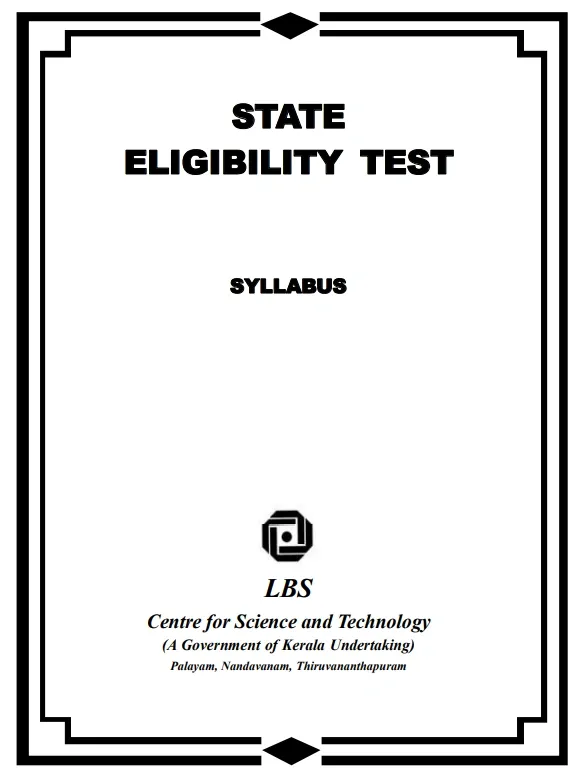
Kerala SET History Syllabus 2026 PDF Download
The official Kerala SET History Syllabus 2026 PDF is the most important resource for candidates preparing for Kerala SET Exam for Paper 2 History. Since every question in the exam is based on the prescribed syllabus, preparing strictly according to the official topics helps avoid unnecessary reading and ensures better time management during the final stages of preparation.
The Kerala SET History Paper 2 syllabus is divided into six major units along with the Kerala SET General Paper to determine candidates’ teaching aptitude, general awareness and understanding of History.
Kerala SET History Syllabus 2026 PDF Includes
- Unit I: Historical Method
- Unit II: Historiography
- Unit III: Kerala History
- Unit IV: Ancient & Medieval Indian History
- Unit V: Modern Indian History
- Unit VI: Select Themes in World History
Candidates should download the latest Kerala SET History Syllabus PDF before preparing their study plan or revision schedule, as it serves as the official reference for the Kerala SET July 2026 examination.
Click Here for Kerala SET History Syllabus 2026 PDF Download
Click Here for Kerala SET Paper 1 Syllabus PDF Download
Kerala SET History Syllabus 2026 (Unit-wise)
Unit I – Historical Method
Module 1.
History as an epistemology of the Past Meaning and scope – various definitions – A social science discipline or part of humanities ?
Module 2.
Inter disciplinarity – The generation of ideology, subjectivity, objectivity and truth
Module 3.
Basic tools and techniques of research. Sources (various kinds) – Methods of authentication – Criticism: internal, external – Textual analysis
Module 4.
Conceptualization – Hypothesis – Presenting an argument – Causation – Generalization (different types) – Frameworks of analysis (Social and Political theories)
Module 5.
Cauterization – citation of sources – Accessories: maps, diagrams, graphs, tables, illustrations – Glossary – Bibliography – Indices – appendices
Unit II Historiography
Module 1.
Historical writings in Ancient India : Vedic texts (Historical consciousness) – Buddhist and Jain Texts – Itihasa Purana – Prasasthis – Dynastic Chronicles – Vamsa Charitas
Module 2.
Trends during the Medieval Period: Arab and Turko-Persian traditions – Regional historical writings – Mughal historiography
Module 3.
Colonial construction of India – Ethnography – Census - Administrative History –Manuels – Surveys and Gazetteers
Module 4.
Nationalist approaches – Neo Colonial writings (Elitist approach, Cambridge school) –Indian Marxist Historiography - Subaltern historiography
Module 5.
Greco – Roman historiography –Medieval historiography - Developments during the Enlightenment
Module 6.
Historical Materialism (Hegel, Karl Marx, Antonio Gramsci) – Structuralist approaches - The Annales School – Sociological theories(Weber,Durkheim,Pierre Bourdieu)
Module 7.
Contemporary Trends : Michel Foucault (History as Discourse, History of Power) – Edward Said (Orientalism) - New Historicism – Post Modernism and History – Gender Studies – Dalit Studies in India.
Unit III Kerala History
Module 1.
Geography of early Kerala – Patterns of Habitat and settlements – The Stone Ages, Megaliths, different phases – Iron Age.
Module 2.
Society as represented in early Tamil writings – cattle raids and wars – chieftaincies – Ecozones (Tinai) – Nature of exchange – Foreign Trade
Module 3.
Dissolution of early social systems – Expansion of organized agriculture, 32 Brahman settlements – Political consolidation under the Perumals - Autocracy or oligarchy? – Nature of land ownership (Dewaswam, Brahmaswam) – Karanmai systems – Adimai form of labour – Trade relations –guilds and emporiavarious taxes – Language, literature and cultural contributions
Module 4.
Breakup of kingdom and the rise of medieval principalities –Swarupam Polity - Economic production – The Jati System – Trade with European powers – Changing functions of temples and the rise of Bhakthi.
Module 5.
Manipravala and growth of Malayalam literature – Temple Arts.
Module 6.
European rivalry for supremacy – Mysorean invasions – Establishment of British Colonial power – Early resistance.
Module 7.
Land revenue policies – Mistaken notions – Popular resistance and their suppression.
Module 8.
Rise of new classes – spread of education – intellectual awakening – colonial modernity? Reforms: Social, religions –Increasing Social Mobility
Module 9.
Towards Freedom: Struggle for Responsible government in Travancore and Cochin – National Movement in Malabar
Module 10.
Nationality problem in Kerala – formation of state - Land reforms and end of Jenny System – Expansion of education – Kerala’s development experience”: its historical roots, sustainability – Migrant labour and post liberalization scenario – Decline of agriculture
Module 11.
Political experiments – coalition governments – Decentralisation and Panchayati Raj – Women in politics
Module 12. Movements of the marginalized – Debates about development and the environment – Ecological concerns (Silent Valley, Plachimada, Depletion of Marine resources) – Waste generation and its disposal – Debates on Western Ghats
Unit IV Ancient and Medieval Indian History
Module 1.
Stone Age Cultures – Harappan Civilization – State and Society in Harappa – City Planning – Craft and Technology – Trade – Religions beliefs - Debates about the decline of Harappan Civilization
Module 2.
Vedic period – Genesis of the term Aryan, language or race ? The PGW culture – NBPW - Political organization – Pastoral economy and its later changes – Upanishadic world
Module 3.
Persian and Macedonian Invasions – Emergency of monarchy in North India – Mahajanapadas – The First Magadha Empire –Expansion of agriculture - The Nandas - Growth of Varna System – Gandhara Art
Module 4.
Establishment of Mauryan empire – Nature of Mauryan State (Recent Interpretations) – Social functions of Asoka’s Dharma – Debates about the decline of the Mauryan Empire- Growth of mercantile classes and urban centers– Buddhism and Jainism – Satavahanas
Module 5.
Consolidation under the Guptas – System of Administration – Developments in Science and Technology – Literature and Art – Bhagavatism – Devolution or decentralization?
Module 6.
Political fragmentation after the Guptas – Harshavardhana – Land grants and agrarian expansion – Decline of trade and Urban decay –Social crisis and Kali - Indian Feudalism ? – Foreign Military incursions to northern India
Module 7.
Medieval India – Rise of Rajput states – Society and Culture - Establishment of Delhi Sultanate – the nobility – the Ulema – Bhakti movement – Sufism – Art and architecture
Module 8.
Classification of land : Iqta, Jagir – Revenue settlement - Irrigation – Craft production – Trade and monetization of economy
Module 9.
South Indian kingdoms – Nature of polity – Segmentary State? - Chalukyas of Vatapi – Pallavas of Kanchi – The Rashtrakutas – Land revenue system under the Chola – Tank irrigation – Pandy of Madura – Landlordisms and Tenurial relations under the Vijayanagara
Module 10.
The Bahmani Kingdom – Accounts of foreign travelers – impact of Islam
Module 11.
Establishment of Mughal empire – Administration and growth of a bureaucracy – Nature of State: Autocratic Patrimonial Bureaucratic , Military, Theocratic ? - Agrarian Economy: Mansabdari, Jagirdari Systems – Guilds : craft and artisan - Banking and Monetary mechanisms – Art and Architecture – Historiography during the Mughal period - Centre Periphery thesis
Unit V Modern Indian History
Module 1.
18th Century India – Important states : The Marathas – The Rajputs – The Sikhs – Growth of British Power – British Economic Policies till 1857 – Civil Rebellions
Module 2.
1857 uprising – various interpretations – Tribal and other resistance movements
Module 3
Colonial Modernity? 19th Century thinkers and their understanding of Indian reality - Social and Religious Reform – Ram Mohan Roy – Derozio - Jyotiba Phule – Arya Samaj – Veerasalingam – Ramakrishna Mission - Vivekananda – Aligarh Movement – Theosophical Society - Changing Notions of Womenhood.
Module 4.
Instruments of social change – Evangelical Agencies – Education – Growth of a ‘middle class’ – creation of a public sphere
Module 5.
Indian as a colonial economy – Growth of plantations – Commercialization of agriculture – Drain of wealth – Deindustrialization – Famines – Impact
Module 6.
Rise of National consciousness – Early political organizations – Indian National Congress – Constitutional methods of agitation, 1905-1920 - Different phases – Non Cooperation Movement – Gandhian techniques – Revolutionary Terrorism – Bhagat Singh – Civil Disobedience Movement – Growth of socialism – Peasant and working class movement – Dr.Ambedkar, EV Ramasamy Naicker – Growth of communalism.
Module 7.
British legislative interventions and their impact (Acts of 1909, 1919 and 1935).
Module 8.
The Second World War and the national movement – The Quit India Movement, Subash Chandra Bose and INA – Postwar developments – Cabinet Mission – Peasant struggles, popular pressure or transfer of power ? - Historiographic debates – Legacies of the national movement.
Module 9.
Integration of Princely States – Nehruvian Model – Planning for a new India – Features of India’s Foreign Policy.
Module 10.
Industrialization – Growth of Agriculture and Green Revolution – Educational Progress – Science and Technology.
Module 11.
Political developments after Nehru – Indira Gandhi and the declaration of internal emergency – Rise of regional political parties – Coalition experiments.
Module 12.
New Education Policy – Economic Reforms since 1991 – The Adivasi question – Environmental struggles – Reservation policy and Mandal Commission – Communal mobilizations – changes in foreign policy.
Unit VI Select Themes World History
Module 1.
Bronze Age Civilizations: Nature of Egyptian Political Power – Religious beliefs and rituals – Trade and Urban centers in ancient Sumeria – Judicial administration in ancient Babylonia – Hammurabi – Military organization in ancient Assyria – Phoenician trade.
Module 2.
Greco-Roman and Judeo Christian foundations – Rise of islam – Caliphate - Feudalism in Europe: Features – Debates about transition to capitalism - Christian church organizations – cultural legacies of medieval period.
Module 3.
Rise of nation states – Voyage of exploration and discovery – Renaissance – Reformation – the new science
Module 4.
Commercial revolution – Mercantilism – Instruments of Monetary transactions – changes in agriculture.
Module 5.
Rise of capitalism – The Age of Reason – Enlightenment thinkers of the 18th century.
Module 6.
Industrial and agrarian revolutions – Technological progress – Social consequences.
Module 7.
Modern revolutions: English, American, French, Russian and Chinese.
Module 8.
Imperialism and the struggle for colonies – scramble for Africa – the Far East, 1870-1918
Module 9.
The first World War–League of Nations – Dictatorships in Europe.
Module 10.
Anti colonial struggles: China, Vietnam, Africa, and Latin America – Different strategies .
Module 11.
United Nations Organization – Post World War politics and the quest for Hegemony – Decolonization – Cold war –Dissarmament and arms control – Oil and geo politics - Bipolar world to Unipolar world – Dominance of Finance Capital: The World Bank and the International Monetary Fund – Economic integration of Europe – NorthSouth dialogue - Liberalization, Privatization and Globalization – BRICS – ‘Arab Spring’ – Post Cold war world.
Download CC Learning App today and prepare for Kerala SET History 2026 with expert guidance, mock tests, and complete syllabus-oriented coaching!
Join Now!
Kerala SET Exam Pattern 2026 for Paper 2 History
Before starting your preparation with the Kerala SET History Syllabus 2026, it is equally important to understand the latest Kerala SET Exam Pattern 2026 for History. The Kerala State Eligibility Test consists of two objective-type papers, both of which are compulsory for candidates appearing with History as their Paper 2 subject.
Paper | Subject | Questions | Marks | Duration |
Paper 1 | General Knowledge & Teaching Aptitude | 120 | 120 | 2 Hours |
Paper 2 | History | 120 | 120 | 2 Hours |
Kerala SET Paper 1 is common for all Kerala SET aspirants and assesses General Knowledge and Teaching Aptitude, whereas Kerala SET Paper 2 evaluates the candidate's postgraduate-level knowledge in History. Since the Kerala SET follows an objective multiple-choice format with no negative marking, candidates should attempt every question to maximise their score.
Read More at:
- Kerala SET July 2026 Notification Out | Eligibility & Application Process
- Kerala SET July 2026 Exam Date Announced! Admit Card & Latest Updates
- Kerala SET July 2026 – Notification, Exam Date, Eligibility & Preparation Guide
- How to Crack Kerala SET January 2026 | Strategy, Syllabus & Preparation Tips
Prepare Kerala SET History with CC Learning App
Preparing the complete Kerala SET History syllabus becomes easier with proper guidance and study plan. The CC Learning App, regarded by thousands of successful candidates as the best SET coaching centre in Kerala, provides complete Kerala SET exam coaching for both Paper 1 and Paper 2, helping aspirants cover the official syllabus systematically.
You will Get
- Complete Kerala SET Exam Online Coaching
- Unit-wise Video Classes
- Paper 1 & Paper 2 Preparation
- Chapter-wise Revision
- Kerala SET Previous Year Question Paper Discussions
- Mock Tests
- Daily Practice Questions
- Current Affairs
- Personal Mentorship
- Regular Revisions
Download CC Learning App today and prepare for Kerala SET History 2026 with expert guidance, mock tests, and complete syllabus-oriented coaching.
Frequently Asked Questions for Kerala SET 2026
Where can I download the Kerala SET History Syllabus 2026 PDF?
Candidates can download the official Kerala SET History Syllabus 2026 PDF from the LBS Centre for Science and Technology website or through the syllabus download link provided in this article.
What are the subjects included in the Kerala SET History Syllabus 2026?
The Kerala SET History Paper 2 syllabus consists of six major units: Historical Method, Historiography, Kerala History, Ancient & Medieval Indian History, Modern Indian History, and Select Themes in World History.
Is the Kerala SET History syllabus based on the postgraduate level?
Yes. Kerala SET History Paper 2 is designed to assess candidates' postgraduate-level knowledge in History. Aspirants should prepare topics covered during their Master's degree along with the official LBS SET syllabus.
How many questions are asked in Kerala SET History Paper 2?
Kerala SET History Paper II consists of 120 objective-type multiple-choice questions, carrying a total of 120 marks.
Is there any negative marking in the Kerala SET History Exam 2026?
No. The Kerala SET History examination does not have negative marking. Candidates are encouraged to attempt all questions to maximise their score.
What is the duration of the Kerala SET History Paper 2 exam?
Kerala SET History Paper 2 is conducted for 2 hours, during which candidates have to answer 120 objective questions.
Notifications
Trending Updates


Related Blogs
April 3, 2026
Kerala SET July 2026 – Notification, Exam Date, Eligibility & Preparation Guide
5 minute read
June 27, 2026
How to Qualify Kerala SET Exam in 30 Days (2026): Study Plan, Pass Marks & Preparation Tips
11 minute read
May 26, 2026