
Table of Contents
Kerala PSC ICDS Supervisor Syllabus 2026 PDF is one of the first things candidates should analyse before beginning upcoming ICDS Supervisor exam 2026 preparation. Unlike general Kerala PSC recruitments, the ICDS Supervisor Syllabus 2026 focuses on child development, social welfare systems, and psychology related subjects connected to Integrated Child Development Services (ICDS). Understand the detailed Kerala PSC ICDS Supervisor Syllabus 2026 PDF early to build an effective ICDS study plan.
Kerala PSC ICDS Supervisor Syllabus 2026 Overview
Kerala PSC ICDS Supervisor Syllabus 2026 includes four major subject areas covering Sociology, Social Work, Psychology, and Community Science/Home Science for the Kerala PSC ICDS Supervisor 2026 exam. The ICDS Supervisor exam 2026 is expected to be conducted as an OMR-based objective exam followed by further recruitment stages including interview and rank list preparation. The following table gives a quick overview of the Kerala PSC ICDS Supervisor Syllabus 2026.
Kerala PSC ICDS Supervisor Syllabus 2026 Factor | Details |
Post Name | Supervisor (ICDS) |
ICDS Supervisor Department | Women and Child Development Department |
ICDS Supervisor 2026 Conducting Authority | Kerala Public Service Commission |
ICDS Full Form | Integrated Child Development Services |
ICDS Supervisor 2026 Exam Mode | OMR / Objective Type Exam |
Total Marks | 100 Marks |
ICDS Supervisor 2026 Subject Distribution | Sociology – 25 Marks Social Work – 25 Marks Psychology – 25 Marks Community Science / Home Science – 25 Marks |
Main Subjects | Sociology, Social Work, Psychology, Community Science |
ICDS Supervisor 2026 Recruitment Type | Direct Recruitment |
ICDS Supervisor 2026 Selection Process | Written Exam + Interview |
ICDS Supervisor 2026 Official Website |
Kerala PSC ICDS Supervisor Syllabus PDF Download
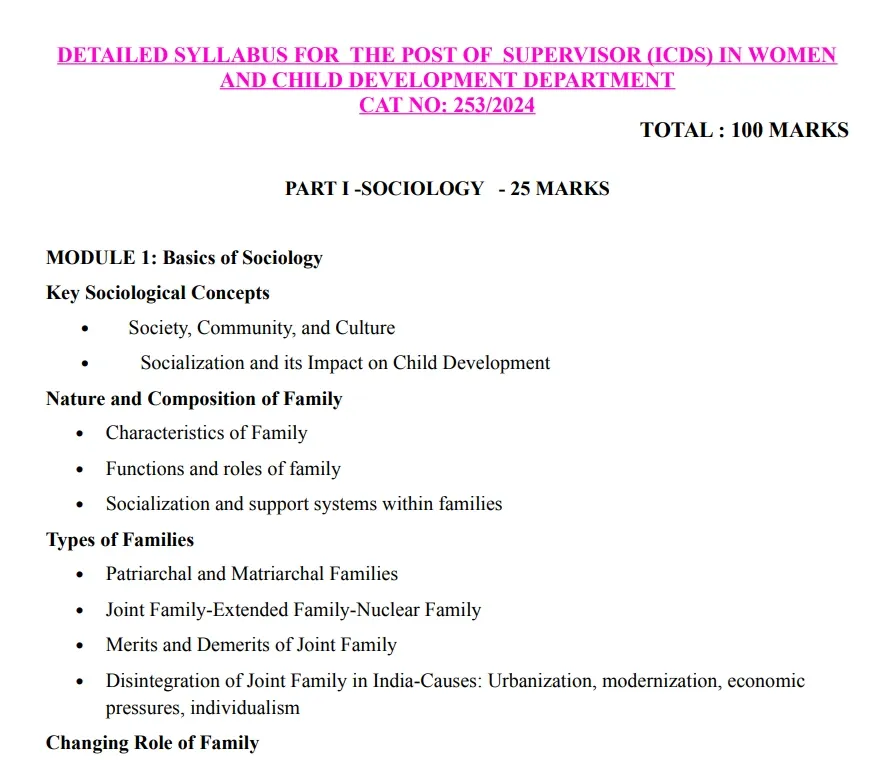
Kerala PSC ICDS Supervisor Syllabus 2026 PDF helps candidates understand the exact subject-wise topics asked for the ICDS Supervisor 2026 exam conducted by Kerala PSC under the Women and Child Development Department. Downloading and referring to the latest Kerala PSC ICDS Supervisor syllabus PDF 2026 helps candidates prepare systematically for the ICDS exam 2026 and improve their shortlist chances.
Click Here for the Kerala PSC ICDS Supervisor Syllabus PDF Download
Kerala PSC ICDS Supervisor Syllabus 2026
DETAILED SYLLABUS FOR THE POST OF SUPERVISOR (ICDS) IN WOMEN AND CHILD DEVELOPMENT DEPARTMENT
TOTAL : 100 MARKS
PART I -SOCIOLOGY - 25 MARKS
MODULE 1: Basics of Sociology
Key Sociological Concepts
- Society, Community, and Culture
- Socialization and its Impact on Child Development
Nature and Composition of Family
- Characteristics of Family
- Functions and roles of family
- Socialization and support systems within families
Types of Families
- Patriarchal and Matriarchal Families
- Joint Family-Extended Family-Nuclear Family
- Merits and Demerits of Joint Family
- Disintegration of Joint Family in India-Causes: Urbanization, modernization, economic pressures, individualism
Changing Role of Family
- Shifting gender roles, women's workforce participation, evolving parental responsibilities
- Modern Trends in Family Structures-Rise in nuclear families, delayed marriages, higher divorce rates, single-parent households (4 Marks)
MODULE 2: SOCIAL PROBLEMS
Domestic Violence and Alcoholism
- Definition, causes, and effects
- Legal frameworks and support systems
Dowry and Dowry Deaths
- Cultural context and consequences
- Legislations and enforcement measures
Drug Addiction
- Types of drugs, causes of addiction, social impact
- Rehabilitation and prevention strategies
Child Labour, Child Abuse and Delinquency
- Forms, causes, and impact on society
- Legal rights and protections for children, POCSO-The Juvenile Justice (Care and Protection of Children) Act 2000
Violence Against Women
- Forms of violence, societal impact
- Legal frameworks and protective measures
Problems of the Elderly
- Social, psychological, and economic issues-Elder Abuse
- Social security measures and elder care
Problems of Transgenders
- Causes, consequences, and solutions
- Government policies and programs
Unemployment and Underemployment
- Causes, consequences, and solutions
- Government policies and programs (6 Marks)
MODULE 3: DEVELOPMENTAL ISSUES
Poverty Alleviation Programmes
- Overview of major programs and their impact
Consumerism
- Definition, causes, and societal impact
Rural-Urban Disparities
- Economic, social, and infrastructural differences
- Government initiatives to bridge the gap
Environmental Degradation
- Air Pollution: Causes, effects, and control measures
- Water Pollution: Sources, consequences, and solutions
- Solid Waste Management: Challenges and strategies
- Climate Change: Causes, impacts, and mitigation
Problems of Induced Displacement
- Social, economic, and cultural issues
- Rehabilitation and resettlement policies (4 Marks)
MODULE 4: WOMEN AND DEVELOPMENT
Women in Governance
- Participation in political and administrative roles
- Challenges and opportunities
Gender Issues
- Gender inequality and discrimination
- Policy interventions and societal changes
Empowerment of Women
- Economic, social, and political empowerment strategies
Participation in Socio-Political Activities
- Role of women in civic engagement and political processes
Women in Panchayat Raj Institutions
- Contributions and challenges faced by women leaders
Role of Self-Help Groups (SHGs)
- Economic and social impact of SHGs on women's development (6 Marks)
MODULE 5: TOOLS AND TECHNIQUES FOR MONITORING AND EVALUATING ICDS PROGRAMMES
Primary and Secondary Data
- Definitions, sources, and methods of collection
Observation Techniques
- Participant Observation: Methods and applications
- Non-Participant Observation: Advantages and limitations
Interview Schedule
- Structured and unstructured interviews
- Techniques for effective interviewing
Questionnaire
- Structured vs. Unstructured questions
- Open vs. Closed questions
Case Study Method-Focus Group Discussion-Participatory Rural Appraisal
- Definition, methodology, and applications
- Advantages and limitations (5 Marks)
PART II - SOCIAL WORK - 25 MARKS
Module | Kerala PSC ICDS Supervisor Social Work Syllabus 2026 | Marks |
Module 1 | Social Work as a Profession
• Historical Evolution of Social Work • Differentiation of Social Service and Social Work • Ideologies, Values, Principles, and Code of Ethics of Social Work Profession • Professional Associations of Social Work – IFSW, IASSW, NAPSWI, ISPSW, KAPS, ASSK • Core Competencies of a Professional Social Worker | 5 Marks |
Module 2 | Primary Methods of Social Work
• Social Case Work – Concept, Principles, Process, Skills, and Scope • Social Group Work – Concept, Principles, Process, Skills, and Scope • Community Organisation – Concept, Principles, Process, Skills, and Scope | 8 Marks |
Module 3 | Secondary Methods of Social Work
• Social Welfare Administration – Concept, Principles, Process, and Scope • Social Action – Concept, Principles, Process, and Scope • Social Work Research – Quantitative, Qualitative, and Mixed Methods • Experimental Research and Sampling • Tools of Data Collection • Statistical Analysis – Measures of Central Tendency, Measures of Dispersion, Correlation, t-Test, ANOVA, Chi Square • Qualitative Designs and Qualitative Data Analysis | 8 Marks |
Module 4 | Social Work Practice in Child Protection
• Social Work Practice in the Context of Child Rights • JJ Systems (CWC, JJB, DCPU, etc.) • ICDS • Kaval and Kaval Plus • Poshan Abhiyaan (National Nutrition Mission) | 4 Marks |
Total | 25 Marks |
PART III - PSYCHOLOGY - 25 MARKS
Module 1. Attention
Consciousness and attention: Controlled and Automatic processes Functions of attention: Vigilance, Selective attention, Divided attention, Sustained attention and Alternating attention Physiological basis of attention. (2 marks)
Module 2. Perception
Nature of perception: Perceptual organization and constancies; Depth perception; Bottom up and top-down approaches: Direct perception. (2 marks)
Module 3. Memory and Forgetting
Models of memory: Atkinson-Shiffin model, Levels of processing model, Working memory model Why we forget: Consolidation theory, Interference theory, Decay theory, Cue dependent forgetting, Displacement theory, Repression, Amnesia. Testing memory: Components of memory tests; WMS and PGI memory test Physiological basis of memory (2 marks)
Module 4 . Intelligence and Creativity
Traditional theories: Two factor theory (Spearman and Cattell); Multifactor theory; Hierarchical model. Structure of intellect model Contemporary theories: Triarchic theory; Multiple intelligence theory; Emotional intelligence theory; PASS model Creativity- Nature of creativity; Stages of creativity, Divergent and Convergent thinking. (2 marks)
Module 5 . Thinking Problem solving:
Types of problem; Approaches to problem solving; Types of heuristics,; Reasoning: Deductive reasoning Syllogistic and Inductive reasoning. (2 marks)
Module 6. Motivation and Emotion
Biological aspects of motivation Instinct theory and Ethology; Homeostasis and arousal theory; Biological needs and drive reduction . Psychological aspects of motivation Locus of control and motivation; Intrinsic and extrinsic motivation; Level of aspiration; Knowledge of result;; Frustration aggression model . Types of emotion, Theories of emotion (James-Lange theory, Cannon-Bard theory, Schachter-Singer theory, theory, Facial feedback theory); Stress and coping.; Biological basis of motivation and emotion. (2 marks)
Module 7. Learning
Learning by association: Classical conditioning , Operant conditioning; Cognitive theories of learning: Latent learning; Insight learning; Verbal learning Neurological basis of learning and memory. (2 marks)
Module 8: Personality
Definition, Psychodynamic perspective : Classical Psychoanalysis: Sigmund Freud, Neoanalytic theories:Carl Jung,Alfred Adler,Karen Horney,Eric Fromm,HarryStack Sullivan,Erik Erikson, Henry Murray’s Personology, Object relations and attachment theories: Margaret Mahler, Bowlby, Behavioural Perspective:Dollard & Miller,B.F.Skinner,Albert Bandura Trait Perspective : G.W. Allport,R. B.Cattell Cognitive and Social cognitive perspective: Lewin’s Field theory, Kelley’s Personal ConstructTheory,Rotter’s locus of control approach ,Bandura’s Social Cognitive learning theory Humanistic Existential Perspective: Carl Rogers Rollo May, VictorFrankl, Abraham Maslow Eastern Perspective:Yoga, The Bhagavad Gita, Sufism, Buddhism Jainism, Taoism. (4 marks)
Module 9. Social perception
Social self : Sources of self-knowledge, Aspects of self-knowledge: Self-schemas, Self-discrepancies, Self-regulation, Selfconcept, Self-esteem, Selfpresentation Perceiving persons : Impression formation and impression management , Attribution: Attribution theories, Attribution biases, Confirmation biases: Perseverance of beliefs, Confirmatory hypothesis testing, The self-fulfilling prophecy Stereotypes, Prejudice, and Discrimination, Attitudes: Measurement,formation, Attitudes and behavior, Persuasion by communication, Persuasion by our own actions, Role playing, Cognitive dissonance theory, Changing attitudes Conformity :Classical studies, Compliance, Obedience: Milgram’s research, Pro-social behaviour, Altruistic personality, Interpersonal influences: perceived characteristic of the person in need, Gender and helping Aggression-culture, Gender and individual difference, Causes of human aggression, Frustration-aggression hypothesis, Negative affect, Prevention and control of aggression. (3 marks)
Module 10 : Psychopathology
Diagnosis and classification of Mental disorders: DSM & ICD classifications. Case taking practices- MSE, MMSE, Clinical interview, Case study, Common signs and symptoms of mental disorders. Neurodevelopmental disorders: Intellectual disabilities, Pervasive and specific developmental disorders, Communication disorders, Autism spectrum disorders, Specific learning disorders, Behavioural and emotional disorders with onset in childhood and adolescence. Major Mental Disorders Schizophrenia spectrum and other psychotic disorders- Schizophrenia, Schizo-typal, Delusional, and other Non-psychotic disorders Affective disorders- Bipolar –depressive disorders Personality disorders , Sexual dysfunctions, Gender dysphoria, Mental and behavioural disorders due to psycho active substance use. Anxiety disorders, Dissociative disorders, Trauma – Stress related, Somatoform disorders,Obsessive – compulsive related disorders.Neurocognitive disorders: Organic mental disorders-Vascular dementia,Delirum. Amnestic disorder. (4 marks)
PART IV - COMMUNITY SCIENCE / HOME SCIENCE - 25 MARKS
Module 1: Child Development (Marks: 12)
- Growth and developmental stages in children
- Factors influencing child development
- Theories of child development
- Importance of play in child development
- Early childhood education and its impact on development
Module 2: Child and Maternal Nutrition (Marks: 8)
- Nutritional needs during pregnancy and lactation
- Impact of maternal nutrition on child health
- Nutritional requirements for different stages of childhood
- Common nutritional deficiencies in children
- Strategies for promoting child and maternal nutrition
Module 3: Preschool Education and Management (Marks: 7)
- Principles and approaches to preschool education
- Curriculum development for early childhood education
- Importance of early childhood education in child development
- Management practices in preschool settings
- Role of a Supervisor in managing preschool education programs
NOTE: - It may be noted that apart from the topics detailed above, questions from other topics prescribed for the educational qualification of the post may also appear in the question paper. There is no undertaking that all the topics above may be covered in the question paper.
Read More at
- Kerala PSC ICDS Supervisor 2026: Notification, Eligibility, Vacancy, Salary, Syllabus & Preparation Guide
- Kerala PSC ICDS Supervisor Salary 2026: Pay Scale & Allowances
- Kerala PSC ICDS Supervisor 2026 Eligibility Criteria: Age Limit & Qualification
Download the CC Learning App and start your Kerala PSC ICDS Supervisor 2026 preparation with systematic syllabus coverage and guided exam support!
Enrol Today!
Prepare for Kerala PSC ICDS Supervisor 2026
Kerala PSC ICDS Supervisor 2026 recruitment attracts a large number of women candidates because of its stable government career, welfare-oriented responsibilities, and promotion opportunities. Candidates who begin Kerala PSC ICDS Supervisor 2026 Preparation early with proper syllabus understanding generally gain a major advantage during the recruitment process.
Kerala PSC ICDS Supervisor Preparation Support through CC Learning App
- Customised ICDS Supervisor Study Plan
- Complete ICDS Supervisor syllabus coverage
- Live & Recorded Classes
- OMR mock tests and revision sessions
- ICDS Supervisor previous question paper discussions
- Personal mentor guidance and doubt-clearing sessions
Download the CC Learning App and start your Kerala PSC ICDS Supervisor 2026 preparation with systematic syllabus coverage and guided exam support.
FAQs
What is the Kerala PSC ICDS Supervisor Syllabus 2026?
Kerala PSC ICDS Supervisor Syllabus 2026 includes Sociology, Social Work, Psychology, and Community Science/Home Science subjects. The syllabus mainly focuses on child development, women welfare, nutrition, social welfare systems, psychology theories, ICDS programmes, and community development topics.
How many marks are allotted for Kerala PSC ICDS Supervisor Exam 2026?
Kerala PSC ICDS Supervisor Exam 2026 is expected to carry a total of 100 marks. Each subject section including Sociology, Social Work, Psychology, and Community Science/Home Science carries 25 marks each.
Is Kerala PSC ICDS Supervisor syllabus difficult?
Kerala PSC ICDS Supervisor syllabus is considered more academic and subject-oriented compared to general Kerala PSC examinations because it includes graduation-level concepts from social science and child welfare-related subjects. Candidates with systematic preparation can score well.
Which subjects are important for Kerala PSC ICDS Supervisor preparation 2026?
Psychology, Social Work, Child Development, Women and Child Welfare Programmes, Nutrition, Sociology, and ICDS-related topics are highly important for Kerala PSC ICDS Supervisor preparation.
Is Psychology important for Kerala PSC ICDS Supervisor Exam 2026?
Yes. Psychology is one of the major sections in Kerala PSC ICDS Supervisor Syllabus 2026 carrying 25 marks. Questions are expected from learning theories, personality, memory, intelligence, psychopathology, and social behaviour topics.
What is ICDS full form in Kerala PSC ICDS Supervisor recruitment 2026?
ICDS full form is Integrated Child Development Services. It is a major women and child welfare programme implemented through Anganwadi systems across India.
Does Kerala PSC ICDS Supervisor syllabus include current affairs?
Yes. Even though the syllabus mainly focuses on academic subjects, candidates should also prepare Kerala current affairs, women welfare schemes, nutrition programmes, and child development-related government initiatives.
How should I prepare for Kerala PSC ICDS Supervisor syllabus 2026?
Candidates should prepare module-wise, revise theories regularly, practice OMR mock tests, study previous question papers, and focus on conceptual understanding instead of memorising facts alone.
Is Community Science/Home Science important in the ICDS Supervisor exam 2026?
Yes. Community Science/Home Science is an important section because ICDS Supervisors directly work with child nutrition, preschool education, maternal care, and Anganwadi welfare programmes.
Notifications
Trending Updates


Related Blogs
May 14, 2026
Kerala PSC ICDS Supervisor 2026: Notification, Eligibility, Vacancy, Salary, Syllabus & Preparation Guide
10 minute read
May 18, 2026
Kerala PSC ICDS Supervisor 2026 Selection Process: Exam Pattern & Recruitment Stages
6 minute read
May 15, 2026