
Table of Contents
Preparing for a Cyber Security Analyst interview in 2026? With cyber threats increasing every day, organisations across India, including Kerala, are actively hiring skilled Cyber Security Analysts and cybersecurity professionals. As a result, Cyber Security jobs are among the fastest-growing career opportunities in the IT industry. Whether you're a fresher, an aspiring SOC Analyst or an experienced professional, scroll down to see the frequently asked Cyber Security Analyst interview questions and answers, practical interview tips and key technical concepts to help you succeed.
Why Are Cyber Security Analyst Jobs in High Demand?
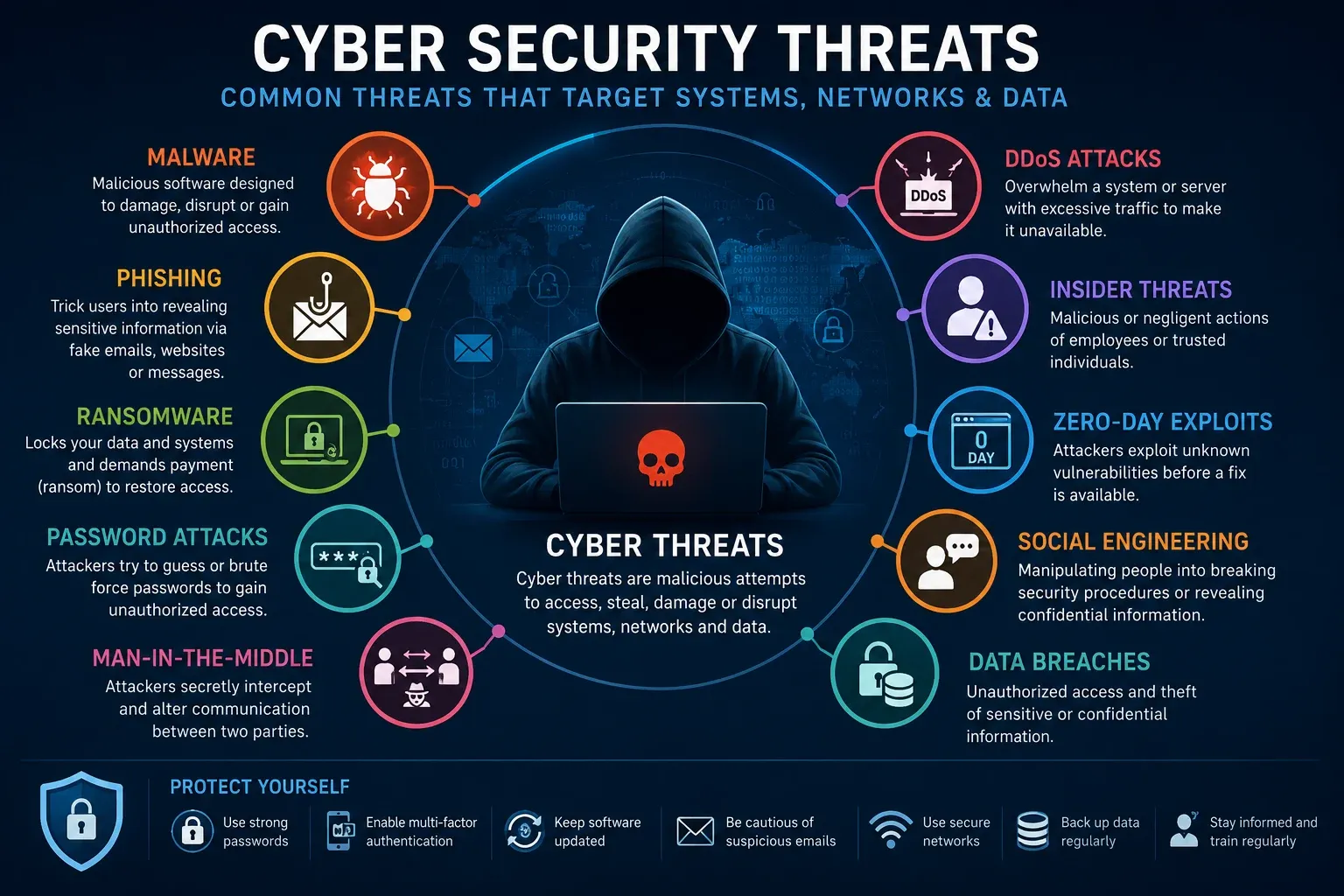
Cyberattacks such as phishing, ransomware, malware, data breaches and Business Email Compromise (BEC) are increasing every year. To protect sensitive data and digital systems, companies are recruiting qualified Cyber Security Analysts with strong technical and analytical skills.
Today, cybersecurity professionals are in demand across:
- IT Companies
- Banks & Financial Institutions
- Healthcare Organizations
- Government Departments
- E-commerce Companies
- Startups & MNCs
For candidates in Kerala and across India, a career in cybersecurity offers excellent job opportunities, competitive salaries and long-term career growth.
What Does a Cyber Security Analyst Do?
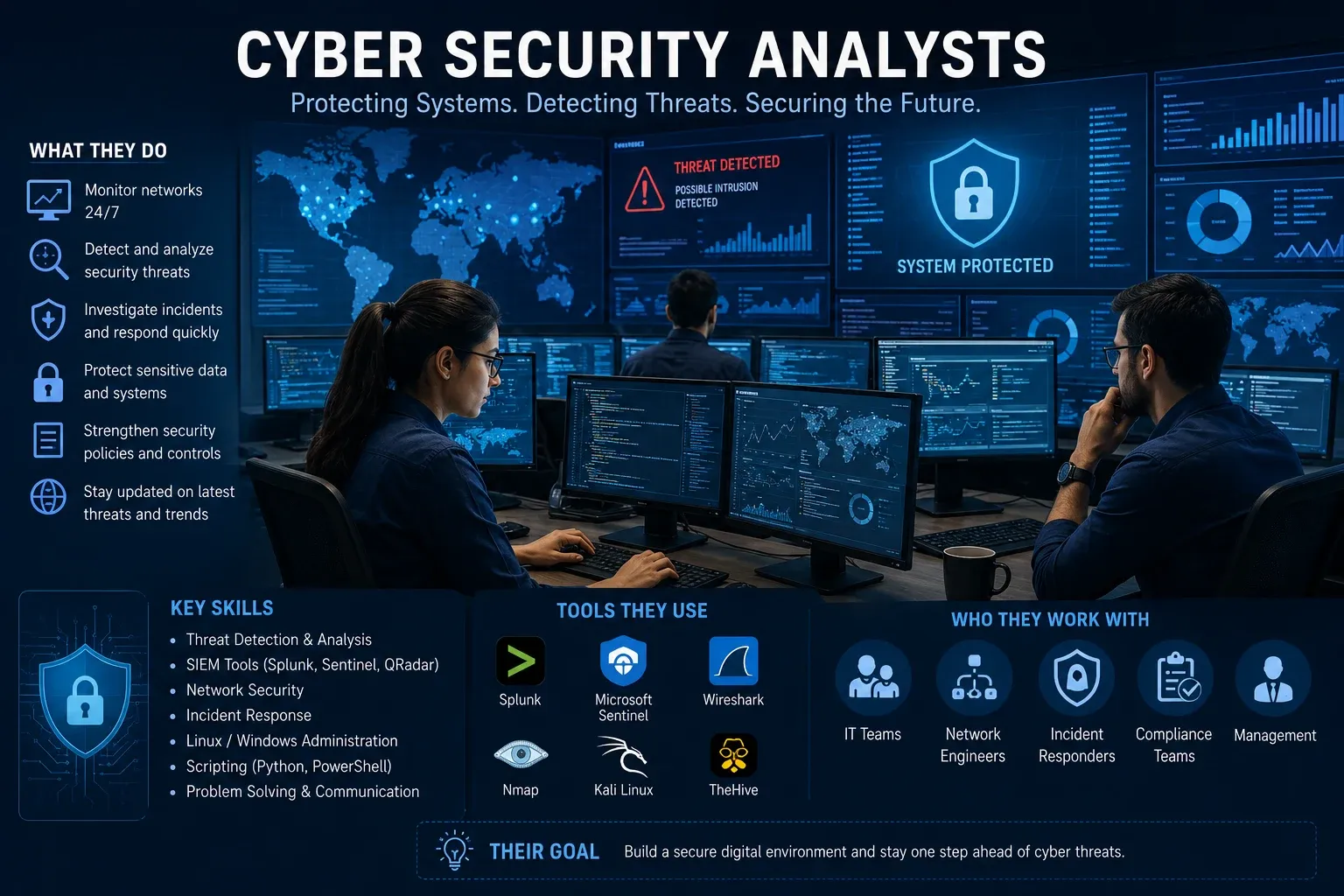
A Cyber Security Analyst is responsible for protecting an organisation's systems, networks, and data from cyber threats. Their daily responsibilities include monitoring security alerts, identifying vulnerabilities, investigating incidents, responding to cyberattacks and improving overall security.
Some common responsibilities include:
- Monitoring security events using SIEM tools
- Detecting malware and phishing attacks
- Conducting vulnerability assessments
- Reviewing firewall and network logs
- Responding to security incidents
- Implementing cybersecurity best practices
What Skills Do Recruiters Look for in a Cyber Security Analyst?
Recruiters look for candidates who have a strong understanding of cybersecurity concepts, network security and problem-solving skills. Along with technical knowledge, employers also value communication, analytical thinking and the ability to respond quickly to security incidents.
- Network Security and TCP/IP Fundamentals
- Ethical Hacking Basics
- Vulnerability Assessment and Risk Management
- Security Information and Event Management (SIEM)
- Incident Response and Threat Analysis
- Firewall, IDS and IPS Configuration
- Cloud Security Fundamentals
- Linux and Windows Administration
- Basic Python or PowerShell Scripting
- Communication and Problem-Solving Skills
Developing these skills can improve your chances of cracking Cyber Security Analyst interviews and securing roles in leading IT companies.
Top 20 Cyber Security Analyst Interview Questions & Answers
1. What is Cyber Security?
Answer: Cybersecurity is the practice of protecting computers, networks, applications, and sensitive data from cyberattacks, unauthorised access, malware, and data breaches through security technologies, policies and best practices.
2. What is the CIA Triad?
Answer: The CIA Triad is the foundation of information security.
- Confidentiality - Protects data from unauthorised access.
- Integrity - Ensures data remains accurate and unaltered.
- Availability - Makes sure authorised users can access data whenever needed.
3. Explain the Difference Between a Threat, Vulnerability and Risk.
Answer:
- Threat: A potential danger that can exploit a system.
- Vulnerability: A weakness in a system that attackers can exploit.
- Risk: The likelihood and impact of a threat exploiting a vulnerability.
4. What is the Difference Between IDS and IPS?
Answer:
- IDS (Intrusion Detection System): Detects suspicious network activity and generates alerts.
- IPS (Intrusion Prevention System): Detects and actively blocks malicious traffic before it reaches the system.
5. What is a Firewall?
Answer: A firewall is a network security device or software that monitors and filters incoming and outgoing network traffic based on predefined security rules to prevent unauthorised access.
6. What is Phishing?
Answer: Phishing is a social engineering attack where attackers send fake emails, messages, or websites to trick users into revealing passwords, banking details or other sensitive information.
7. What is Malware?
Answer: Malware is malicious software designed to damage, disrupt or gain unauthorised access to systems. Common types include viruses, worms, ransomware, spyware and trojans.
8. What is Multi-Factor Authentication (MFA)?
Answer: Multi-Factor Authentication (MFA) is a security method that requires users to verify their identity using two or more authentication factors, such as a password and a one-time password (OTP) or biometric verification.
9. What is a VPN?
Answer: A Virtual Private Network (VPN) creates a secure, encrypted connection between a user's device and the internet, protecting data privacy and enabling secure remote access.
10. What is Encryption?
Answer: Encryption is the process of converting readable data into an unreadable format (ciphertext) using cryptographic algorithms to protect sensitive information from unauthorised access.
11. What Is SIEM? Why Is It Important?
Answer: Security Information and Event Management (SIEM) is a security solution that collects, monitors and analyses logs from multiple devices and applications in real time. It helps security teams detect suspicious activities, investigate incidents and respond to cyber threats quickly.
Some popular SIEM tools include:
- Splunk
- Microsoft Sentinel
- IBM QRadar
- ArcSight
12. What is Vulnerability Assessment?
Answer: Vulnerability Assessment is the process of identifying, analysing and prioritising security weaknesses in systems, applications or networks so they can be fixed before attackers exploit them.
13. What is Incident Response?
Answer: Incident Response is the structured process of detecting, investigating, containing and recovering from cybersecurity incidents such as malware infections, ransomware attacks or data breaches.
14. What is Multi-Factor Authentication (MFA)?
Answer: Multi-Factor Authentication (MFA) is a security process that requires users to verify their identity using two or more authentication methods, such as a password, OTP, fingerprint or security key.
15. What Is the Difference Between Vulnerability Assessment and Penetration Testing?
Answer:
Vulnerability Assessment | Penetration Testing |
Identifies security weaknesses | Actively exploits vulnerabilities |
Focuses on finding vulnerabilities | Focuses on testing real-world attack scenarios |
Lower risk | Simulates actual cyberattacks |
Used for continuous security improvement | Used to validate an organization's security posture |
16. What Is EDR?
Answer: Endpoint Detection and Response (EDR) is a cybersecurity solution that continuously monitors endpoint devices such as laptops, desktops, and servers. It detects suspicious activities, investigates threats and enables security teams to isolate infected devices before an attack spreads.
Popular EDR solutions include Microsoft Defender for Endpoint, CrowdStrike Falcon and SentinelOne.
17. How Would You Investigate a Suspicious Login Alert?
Answer: A structured approach includes:
- Review the alert details.
- Verify the user's identity and login location.
- Check the source IP address and device information.
- Analyse authentication and endpoint logs.
- Look for unusual user behavior or multiple failed login attempts.
- Determine whether the activity is legitimate or malicious.
- Take necessary actions such as resetting passwords or blocking access if required.
18. What Is Threat Hunting?
Answer: Threat hunting is the proactive process of searching for hidden cyber threats that may bypass traditional security tools. Cyber Security Analysts use threat intelligence, behavioral analysis, and log investigation to identify malicious activities before they cause damage.
19. Explain the Difference Between Authentication and Authorisation.
Answer: Authentication verifies a user's identity using credentials such as passwords, biometrics or OTPs. Authorisation determines what resources or actions an authenticated user is allowed to access. Authentication happens first, followed by authorisation.
20. What Is the Primary Role of a SOC Analyst?
Answer: A Security Operations Centre (SOC) Analyst continuously monitors security events, investigates alerts, detects cyber threats, responds to incidents and helps protect an organisation's IT infrastructure.
Cyber Security Analyst Career Scope in India
The demand for Cyber Security Analysts is growing rapidly as organisations strengthen their defenses against cyber threats. Industries such as IT, banking, healthcare, e-commerce, telecommunications, government and fintech are actively hiring cybersecurity professionals to protect sensitive data and digital infrastructure.
For candidates in Kerala, opportunities are expanding across IT hubs like Technopark, Infopark and leading multinational companies. With the right skills, certifications and practical knowledge, aspiring professionals can build a rewarding career in cybersecurity.
Some of the popular job roles include:
- Cyber Security Analyst
- SOC Analyst
- Information Security Analyst
- Security Operations Engineer
- Incident Response Analyst
- Vulnerability Assessment Analyst
- Threat Intelligence Analyst
- Network Security Engineer
- Cloud Security Analyst
- Penetration Tester
Top Cyber Security Certifications
Earning globally recognised cybersecurity certifications is one of the best ways to improve your skills, strengthen your resume, and stand out in today's competitive job market. These certifications validate your technical expertise and increase your chances of securing high-paying Cyber Security Analyst and SOC Analyst roles.
Some of the most valuable cybersecurity certifications include:
- CompTIA Security+
- Certified Ethical Hacker (CEH)
- CompTIA CySA+
- Cisco Certified CyberOps Associate
- ISC2 Certified in Cybersecurity (CC)
- Certified Information Systems Security Professional (CISSP)
- Microsoft Certified: Security Operations Analyst Associate (SC-200)
- Google Cybersecurity Professional Certificate
Whether you're a fresher or an experienced professional, these certifications demonstrate your commitment to continuous learning and help you build a successful career in the fast-growing cybersecurity industry.
Cyber Security Analyst Salary in India
A Cyber Security Analyst's salary in India varies based on factors such as experience, technical expertise, certifications, location and the organisation. As the demand for cybersecurity professionals continues to grow, companies are offering competitive salary packages to attract skilled talent.
Experience | Average Salary (India) |
Fresher (0 - 2 Years) | ₹4 - ₹7 LPA |
Mid-Level (3 - 5 Years) | ₹7 - ₹12 LPA |
Experienced (5+ Years) | ₹12 - ₹20+ LPA |
Earning globally recognized Cyber Security certifications and gaining hands-on experience can further accelerate your career growth and increase your earning potential.
Common Mistakes to Avoid During a Cyber Security Interview
Preparing thoroughly, staying confident and explaining concepts with practical examples will help you stand out from other candidates. Avoid these mistakes to improve your chances of success:
- Memorising answers without understanding the concepts.
- Ignoring networking fundamentals.
- Not staying updated on the latest cyber threats.
- Giving lengthy or unclear explanations.
- Failing to demonstrate practical knowledge.
- Overlooking communication and soft skills.
- Not researching the company before the interview.
Preparing thoroughly, staying confident and explaining concepts with practical examples will help you stand out from other candidates.
Start Your Cyber Security Journey with the CC Learning App
Ready to build a successful Cyber Security career? CC Learning App is a multi-learning platform that helps students and professionals develop the skills needed for today's fast-growing cybersecurity industry. Learn Cyber Security, Ethical Hacking, Network Security, SOC Operations and other in-demand topics through expert-led classes and practical learning.
Whether you're preparing for your first Cyber Security Analyst interview, planning to earn industry certifications, or looking for a Cyber Security job, CC Learning App provides the guidance and support you need to achieve your career goals. Start learning today and take the first step toward becoming a skilled Cyber Security Analyst.
Frequently Asked Questions
1. What are the most common Cyber Security Analyst interview questions?
Most Cyber Security Analyst interview questions focus on topics like the CIA Triad, firewalls, IDS vs IPS, encryption, phishing, malware, SIEM, incident response, cloud security, vulnerability assessment and network security. Interviewers may also ask practical and scenario-based questions.
2. Is Cyber Security a good career in 2026?
Yes. Cyber Security is one of the fastest-growing career fields. Companies across IT, banking, healthcare, fintech and government are hiring skilled Cyber Security Analysts, creating excellent job opportunities.
3. Can freshers become Cyber Security Analysts?
Yes. Freshers can start a career in Cyber Security by learning networking, operating systems, cybersecurity basics and earning relevant certifications. Hands-on practice also helps during interviews.
4. Which programming languages are useful for Cyber Security?
Basic knowledge of Python, PowerShell, Bash, JavaScript and SQL is useful for scripting, automation and security analysis.
5. Which Cyber Security tools should I learn before an interview?
Learning popular Cyber Security tools can improve your interview performance. Some important tools are:
- Wireshark
- Nmap
- Burp Suite
- Nessus
- Splunk
- Microsoft Sentinel
- Metasploit
- Kali Linux
6. What skills do employers look for in a Cyber Security Analyst?
Employers look for skills in network security, SIEM, incident response, cloud security, Linux, Windows administration, vulnerability assessment and scripting. Good problem-solving and communication skills are also important.
Trending Updates



Related Blogs
December 20, 2025
Why Cybersecurity Courses Really Matter in 2026?
4 minute read
March 21, 2026
What is CERT in Cyber Security?
6 minute read
February 21, 2026
7 Essential Types of Cybersecurity: The Complete Guide for 2026
6 minute read
November 28, 2025