
Table of Contents
Performance marketing is no longer optional; it has become a survival strategy for businesses in 2026. With rising ad costs and intense digital competition, brands need campaigns that deliver real, measurable results. Unlike traditional advertising, performance-based marketing ensures businesses pay only for actions like clicks, leads and sales. With real-time tracking and data-driven optimisation, digital performance marketing helps brands maximise ROI and stay ahead of competitors in today’s result-driven advertising landscape.
Performance Marketing
Performance marketing is a performance-based advertising model where advertisers pay only when a specific, measurable action is completed. These actions include:
- Website clicks
- Lead submissions
- App installs
- Purchases or subscriptions
Common pricing models include CPC (Cost Per Click), CPA (Cost Per Action), CPM (Cost Per Mille) and CPL (Cost Per Lead).
Unlike traditional campaigns, performance marketing delivers accountability, transparency and measurable ROI, making it ideal for startups, SMEs and large enterprises alike.
Enrol Now on the Best Performance Training of CC Learning App
Tap Here
How Does Performance Marketing Work?
1. Goal Setting
Every performance marketing strategy begins with clearly defined goals:
- Performance based lead generation
- Online sales
- Brand engagement
- App downloads
- Website traffic
These goals are directly linked to marketing key performance indicators such as conversion rate, cost per acquisition, return on ad spend (ROAS) and customer lifetime value.
2. Channel Selection
Brands choose the most effective online performance marketing channels based on audience behavior and intent. Popular options include:
- Google Ads (Search & Display)
- Social media ads
- Affiliate marketing
- Influencer collaborations
- Email and video platforms
3. Ad Creation & Targeting
Ads are designed to be conversion-focused, not just visually appealing. Advanced targeting ensures ads reach the right audience using:
- Demographics
- Interests
- Online behavior
- Retargeting and lookalike audiences
This precision improves campaign performance and reduces wasted spend.
4. Tracking & Analytics
Using advanced performance marketing reporting tools, every interaction is tracked in real time. Businesses gain insights into:
- Click-through rates (CTR)
- Conversion paths
- Audience behavior
- Channel efficiency
This data forms the foundation for campaign performance analysis.
5. Optimisation & Scaling
Underperforming ads are paused, high-converting ads are scaled and budgets are reallocated to maximise marketing performance. This continuous optimisation is what makes performance marketing highly scalable.
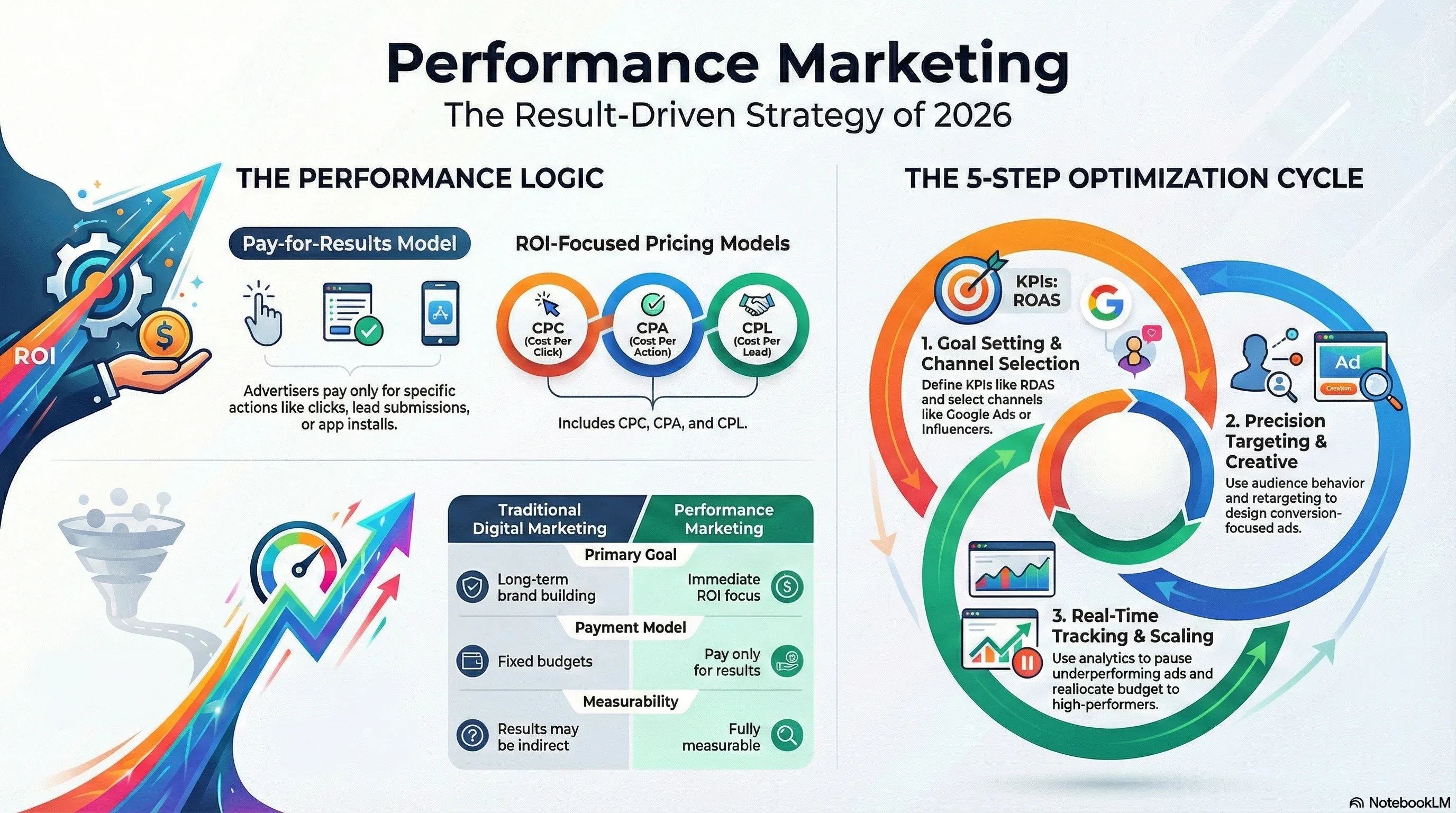 Source : Notebook LM
Performance Marketing vs Digital Marketing
Digital marketing means promoting products, services or brands using the internet and digital platforms like websites, social media, search engines, email and mobile apps to reach people online. This includes SEO, content marketing, email marketing and social media management.
Performance marketing is a subset of digital marketing that focuses exclusively on measurable outcomes, where advertisers pay only for specific actions such as clicks, leads or sales. For ROI-focused businesses, performance-based online marketing delivers faster and clearer results.
Digital Marketing | Performance Marketing |
Long-term brand building | Immediate ROI focus |
Results may be indirect | Pay only for results |
Harder to track ROI | Fully measurable |
Fixed budgets | Flexible & performance-based |
Why Performance Based Advertising Is Growing Rapidly?
The global shift toward performance advertising is driven by several factors:
- Rising customer acquisition costs
- Demand for transparency
- Advanced analytics and AI tools
- Budget efficiency
- Real-time performance tracking
Brands no longer want assumptions; they want data-backed results.
Want More Details About Digital Marketing?
Tap Here
Role of a Performance Marketing Firm
A performance marketing firm helps businesses:
- Reduce trial and error costs
- Track campaign performance clearly
- Improve marketing KPI’s and results
- Run effective performance-based advertising
- Achieve better ROI through measurable outcomes

The Future of Performance Marketing in 2026
The future of performance marketing is driven by AI-based optimization, predictive analytics, privacy-first tracking and cross-channel attribution, enabling businesses to improve marketing performance, enhance performance marketing reporting, optimize campaign performance analysis and achieve higher ROI through data-driven digital performance marketing strategies.
How to Choose the Right Performance Marketing Channel?
Selecting the right performance marketing channel depends on clearly defined business goals such as leads, sales or installs, a deep understanding of target audience behaviour, available budget and scalability and reliable tracking and analytics tools. Brands that combine multiple performance marketing channels often see stronger campaign performance and more consistent results.
Related Blogs
- Types of Performance Marketing Channels
- Why Performance Marketing Is Important for Businesses?
- What is GEO (Generative Engine Optimization)?
- Why AI-Integrated Digital Marketing Courses Are in High Demand in 2025-26?
- What Is the Difference Between Content Writing & Copywriting?
- Importance of a Landing Page for Advertising in 2026
Learn Performance Marketing: Channel Strategy for Real Results
Successful performance marketing depends on using the right mix of performance marketing channels, not a single platform. By combining Google Search Ads, social media advertising, affiliate marketing and influencer performance campaigns with clear business goals, audience behaviour and measurable outcomes, brands achieve consistent data-driven digital growth.
To learn performance marketing or build a career in digital and performance marketing, the CC Learning App offers app-based learning with expert tutoring and hands-on training.
Download the CC Learning App and start learning performance marketing through a results-focused, real-world approach.
Download CC Learning App Now & Start Learning Performance Marketing Today
Tap Here
Frequently Asked Questions
1. What is performance marketing?
Performance marketing is a performance-based advertising model where advertisers pay only when a measurable action, such as a click, lead, app install or sale is completed.
2. How is performance marketing different from digital marketing?
Digital marketing includes all online promotion methods, while performance marketing is a subset of digital marketing that focuses only on measurable outcomes and pay-for-results campaigns.
3. What are the common pricing models used in performance marketing?
Common pricing models include CPC (Cost Per Click), CPA (Cost Per Action), CPM (Cost Per Mille) and CPL (Cost Per Lead).
4. Which businesses can benefit from performance marketing?
Startups, small and medium enterprises (SMEs) and large businesses can all benefit from performance marketing due to its measurable ROI and budget flexibility.
5. What are the key marketing KPIs in performance marketing?
Important marketing KPIs include conversion rate, cost per acquisition, return on ad spend (ROAS), click-through rate (CTR) and customer lifetime value.
6. What are the top performance marketing channels in 2026?
Top channels include Google Search Ads, social media advertising, affiliate marketing, influencer campaigns, email marketing and video advertising platforms.
7. Why is performance-based advertising growing rapidly?
Performance-based advertising is growing due to rising ad costs, demand for transparency, advanced analytics tools and the need for real-time performance tracking.
8. How does performance marketing help improve ROI?
Performance marketing improves ROI by tracking every action, optimizing campaigns in real time and allocating budgets only to high-performing channels.
9. What is the role of a performance marketing firm?
A performance marketing firm helps businesses plan strategies, track campaign performance, optimize marketing KPIs and improve overall marketing performance and ROI.
10. Can performance marketing help build a career in digital marketing?
Yes, performance marketing skills are highly in demand and offer strong career opportunities in digital and performance marketing roles across industries.
Trending Updates