
Table of Contents
The Kerala PSC Scientific Officer Document Syllabus 2027 is designed around advanced concepts from Physics and Chemistry, reflecting the scientific and analytical requirements of the Document stream under the Kerala Police Service, Forensic Science Laboratory. The syllabus covers postgraduate-level topics including Classical Mechanics, Quantum Mechanics, Electronics, Spectroscopy, Organic Chemistry, Physical Chemistry, Analytical Chemistry and Material Chemistry.
Get the complete KPSC Scientific Officer Document syllabus, module-wise marks, detailed topics, exam structure, preparation strategy and important points to help aspirants plan their preparation for the upcoming Kerala PSC Scientific Officer recruitment 2027.
Kerala PSC Scientific Officer Document Syllabus 2027 – Overview
Particulars | Details |
Post | |
Department | Kerala Police Service – Forensic Science Laboratory |
KPSC Scientific Officer Syllabus Level | Postgraduate Level |
KPSC Scientific Officer Total Marks | 100 |
KPSC Scientific Officer Syllabus 2027 Part I | Physics – 50 Marks |
KPSC Scientific Officer Syllabus 2027 Part II | Chemistry – 50 Marks |
KPSC Scientific Officer Document Syllabus 2027 Physics Modules | 10 |
KPSC Scientific Officer Document Syllabus 2027 Chemistry Modules | 10 |
KPSC Scientific Officer Document Syllabus 2027 Marks per Module | 5 Marks |
KPSC Scientific Officer Exam Mode | OMR |
KPSC Scientific Officer Exam Duration | 1 Hour 30 Minutes |
KPSC Scientific Officer Exam Medium | English |
Kerala PSC Official Website |
The last Kerala PSc Scientific Officer Document Exam under category number 635/2023 was conducted statewide on 2 December 2024, through OMR for 100 marks, with a duration of 1 hour 30 minutes and English as the medium.
For Kerala PSC 2027 preparation, candidates should use the official Kerala PSC Scientific Officer Notification and syllabus applicable to the new recruitment as the final authority.
Kerala PSC Scientific Officer Document Syllabus PDF Download
The latest available detailed Kerala PSC Scientific Officer Document Syllabus 2027 is for Scientific Officer (Document), Category No. 635/2023, contains 100 marks, divided equally between Part I - Physics (50 marks) and Part II - Chemistry (50 marks). Each part contains 10 modules, with each module carrying 5 marks.
Candidates preparing for the KPSC Scientific Officer Document exam 2027 can refer to the official detailed syllabus issued by the Kerala Public Service Commission.
Click Here for Kerala PSC Scientific Officer Biology Syllabus 2027 PDF Download
Kerala PSC Scientific Officer Document Syllabus: Exam Structure
KPSC Scientific Officer Exam Pattern 2027 | |
Part I – Physics | 50 Marks |
Module & Syllabus Area | Marks |
Module I – Classical Mechanics | 5 |
Module II – Mathematical Methods and Group Theory | 5 |
Module III – Electronics | 5 |
Module IV – Quantum Mechanics | 5 |
Module V – Statistical Mechanics | 5 |
Module VI – Nuclear and Particle Physics | 5 |
Module VII – Solid State Physics | 5 |
Module VIII – Atomic and Molecular Spectroscopy | 5 |
Module IX – Microprocessor | 5 |
Module X – Lasers and Fibre Optics | 5 |
Part II – Chemistry: | 50 Marks |
Module & Syllabus Area | Marks |
Module I – Inorganic Chemistry-1 | 5 |
Module II – Inorganic Chemistry-2 | 5 |
Module III – Inorganic Chemistry-3 | 5 |
Module IV – Organic Chemistry-1 | 5 |
Module V – Organic Chemistry-2 | 5 |
Module VI – Organic Chemistry-3 | 5 |
Module VII – Physical Chemistry-1 | 5 |
Module VIII – Physical Chemistry-2 | 5 |
Module IX – Physical Chemistry-3 | 5 |
Module X – Analytical, Environmental, Material and Supramolecular Chemistry | 5 |
Total Questions | 100 |
Total Marks | 100 |
The detailed Kerala PSC Scientific Officer Document Syllabus 2027 specifies the marks assigned to each module but does not provide a separate module-wise question count. Therefore, candidates should not assume that each 5-mark module necessarily contains a fixed number of questions.
Kerala PSC Scientific Officer Document Syllabus 2027
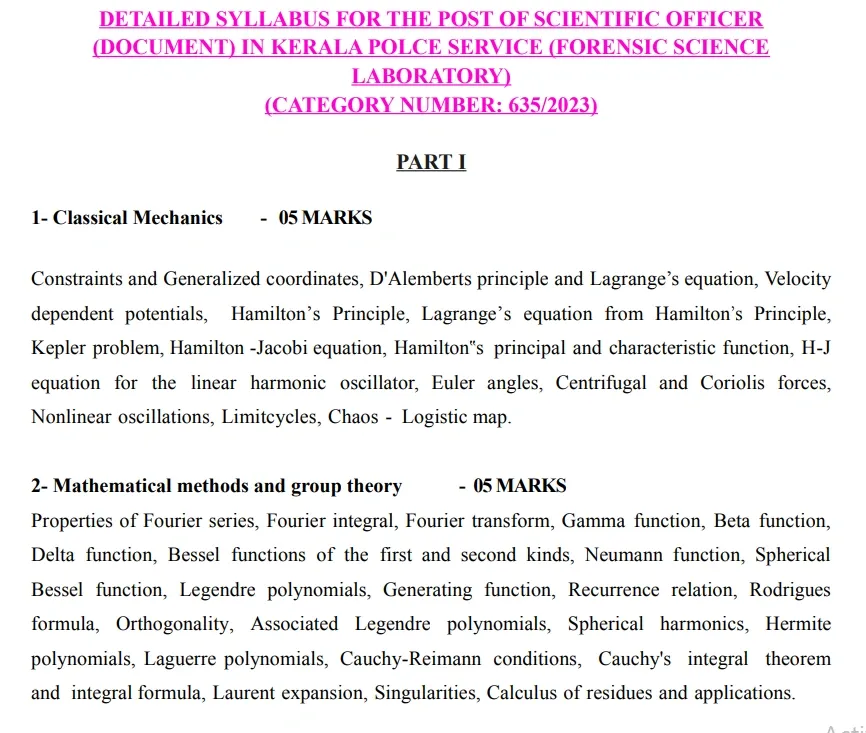
DETAILED SYLLABUS FOR THE POST OF SCIENTIFIC OFFICER (Document) IN KERALA POLICE SERVICE (FORENSIC SCIENCE LABORATORY)
(Total Marks – 100)
PART I : PHYSICS (50 Marks)
Module I – Classical Mechanics – 5 Marks
The Classical Mechanics module focuses on advanced mechanics and mathematical formulations of physical systems.
Major topics include:
- Constraints and generalized coordinates
- D'Alembert's principle
- Lagrange's equations
- Velocity-dependent potentials
- Hamilton's principle
- Lagrange's equation from Hamilton's principle
- Kepler problem
- Hamilton-Jacobi equation
- Hamilton's principal and characteristic functions
- H-J equation for the linear harmonic oscillator
- Euler angles
- Centrifugal and Coriolis forces
- Nonlinear oscillations
- Limit cycles
- Chaos and logistic map
Module II – Mathematical Methods and Group Theory – 5 Marks
This module covers mathematical tools used extensively in advanced Physics.
Important areas include:
- Fourier series
- Fourier integral and Fourier transform
- Gamma and Beta functions
- Delta function
- Bessel functions
- Neumann functions
- Spherical Bessel functions
- Legendre polynomials
- Generating and recurrence relations
- Rodrigues formula
- Orthogonality
- Associated Legendre polynomials
- Spherical harmonics
- Hermite and Laguerre polynomials
- Cauchy-Riemann conditions
- Cauchy's integral theorem and integral formula
- Laurent expansion
- Singularities
- Calculus of residues and applications
Module III – Electronics – 5 Marks
The Electronics module covers semiconductor devices, operational amplifiers, filters, communication systems and related electronic circuits.
Key areas include:
- FET biasing
- FET as voltage-variable resistor
- Photodetectors
- Light-dependent resistors
- Photodiodes
- p-n junction solar cells
- Operational amplifier characteristics and parameters
- Differential amplifier
- OPAMP inverter
- Analog integration and differentiation
- Electronic analog computation
- Active low-pass and high-pass filters
- Butterworth filters
- Band-pass filters
- Astable and monostable multivibrators
- Schmitt trigger
- Amplitude modulation and demodulation
- Signal-to-noise ratios
- Pulse code modulation
- Communication receivers
- FM transmitters
- VHF/UHF systems
- Microwave systems
- Satellite communications
Module IV – Quantum Mechanics – 5 Marks
The Quantum Mechanics section includes:
- Vector spaces
- Hilbert space
- Operators and their properties
- Angular momentum operators
- Matrix representation of angular momentum
- Pauli spin matrices
- Orbital angular momentum
- Differential and total cross-sections
- Optical theorem
- Harmonic perturbation
- Interaction of atoms with electromagnetic fields
- Induced emission and absorption
- Anharmonic oscillator
- Stark and Zeeman effects in hydrogen
- Hole theory
- Weyl equation
- Klein-Gordon equation
- Charge and current densities
Module V – Statistical Mechanics – 5 Marks
The syllabus includes:
- Entropy of mixing
- Gibbs paradox
- Phase space of a classical system
- Liouville's theorem and consequences
- Equipartition theorem
- Virial theorem
- Density matrix
- Thermodynamic behaviour of an ideal Bose gas
- Thermodynamic behaviour of an ideal Fermi gas
- Pauli paramagnetism
- Landau diamagnetism
Module VI – Nuclear and Particle Physics – 5 Marks
Important areas include:
- Nuclear size, shape, mass and binding energy
- Semi-empirical mass formula
- Nuclear forces
- Spin-orbit potential
- Electric quadrupole moments
- Parity violation in beta decay
- Internal conversion
- Conservation laws and symmetries
- Quark model
- Eightfold way
- Quantum chromodynamics
- Gluons
- Fick's law and its validity
- Shell structure and magic numbers
- Single-crystal and powder diffraction
- Scherrer equation
- Debye-Scherrer camera
- Applications of X-ray diffraction
Module VII – Solid State Physics – 5 Marks
The Solid State Physics module covers:
- Miller indices
- Reciprocal lattice
- Brillouin zones
- Einstein and Debye models of specific heat
- Nearly free electron model
- Formation of energy bands
- Bloch functions
- Kronig-Penney model
- Dielectric constant
- Local electric field
- Ferroelectric domains
- Antiferroelectricity
- Piezoelectricity
- Langevin theory of diamagnetism
- Weiss theory of ferromagnetism
- Néel model of antiferromagnetism
- Type I and Type II superconductors
- Energy gap
- Isotope effect
- London equation
- Cooper pairs
- High-Tc superconductors
- Cuprates
Module VIII – Atomic and Molecular Spectroscopy – 5 Marks
This module includes:
- Spectrum of a non-rigid rotator
- Born-Oppenheimer approximation
- Normal modes and vibrations of H₂O and CO₂
- Rotational Raman spectrum of symmetric-top molecules
- Stimulated Raman effect
- Inverse Raman effect
- Vibrational analysis of band systems
- Deslandres' table
- Interaction of nuclear spin and magnetic field
- Larmor precession
- Mössbauer spectroscopy
- Resonance fluorescence of gamma rays
Module IX – Microprocessor – 5 Marks
The Microprocessor module covers:
- Organization of microcomputers
- Microprocessor as CPU
- Addition and subtraction of 8-bit and 16-bit numbers
- Internal architecture of Intel 8085
- Timing of Intel 8085
- Data transfer schemes
- Applications of microprocessors
- Analog-to-digital converter
- Clock for A/D conversion
- Sample-and-hold circuit
- Analog multiplexer
- Overview of 8051 microcontroller
Module X – Lasers and Fibre Optics – 5 Marks
The final Physics module includes:
- Einstein coefficients
- Line-broadening mechanisms
- Q-switching
- Mode locking
- Four-level solid-state lasers
- CO₂ lasers
- Dye lasers
- Semiconductor lasers
- Spatial frequency filtering
- Holography
- Second harmonic generation
- Acceptance angle of optical fibre
- Numerical aperture
- Step-index fibres
- Graded-index fibres
- Attenuation in optical fibres
- Absorption losses
- Leaky modes
- Radiation-induced losses
- Inherent defect losses
PART I : CHEMISTRY (50 Marks)
Module I – Inorganic Chemistry-1 – 5 Marks
The module covers:
- Structure and bonding in molecules
- Chemical periodicity
- Hydrogen and s-block elements
- p-block and d-block elements
- Extractive chemistry of commercially important metals
- Non-transition elements
- Theories of acids and bases
- HSAB concept
- Solvent effects
- Linear free energy relationship
- Super acids
- Non-aqueous solvents
- Isopoly and heteropoly acids
- Silicon-oxygen compounds
- Zeolites
- Xenon and krypton compounds
- Sulphur-nitrogen and sulphur-phosphorus compounds
- Phosphorus-nitrogen and boron-nitrogen compounds
- Boron hydrides
- Organoboranes
- Carboranes and metallocarboranes
- STYX and WADE rules
- Lanthanides and actinides
- Coordination chemistry
- Werner's theory
- Crystal field theory
- Ligand field theory
- Molecular orbital theory
- Stereochemistry of coordination compounds
- Jahn-Teller distortion
- Stability and reactions of metal complexes
- Electron transfer, substitution and photochemical reactions
Module II – Inorganic Chemistry-2 – 5 Marks
Important areas include:
- Energy-level diagrams
- Correlation diagrams
- Term symbols
- Orgel diagrams
- Tanabe-Sugano diagrams
- Symmetry and selection rules
- Electronic, IR, Raman, NMR, ESR and Mössbauer spectra
- Magnetic properties of complexes
- Spectroscopic methods in inorganic chemistry
- CD and ORD spectra
- NMR of metal nuclides
- ESR applications
- Mössbauer spectroscopy
- Organometallic compounds
- Metal carbonyls and cyanides
- Olefin, acetylene, diene and allyl complexes
- Cyclopentadiene and benzene complexes
- Ferrocene and dibenzenechromium
- Metal-metal bonds and metal clusters
- Zintl anions and cations
- Catalysis by organometallic compounds and metal clusters
- Essential and trace metals in biological systems
- Biological membranes and ion transport
- Photosynthesis and chlorophyll
- Inorganic medicinal chemistry
Module III – Inorganic Chemistry-3 – 5 Marks
This module focuses on nuclear, solid-state and advanced inorganic chemistry.
Topics include:
- Nuclear reactions
- Nuclear structure and stability
- Magic numbers
- Nuclear models
- Radioactive equilibria
- Radioactive decay and growth
- Direct nuclear reactions
- Heavy-ion-induced nuclear reactions
- Photonuclear reactions
- Neutron capture cross-section
- Critical size
- Fission and fusion
- Neutron activation analysis
- Counting techniques
- Crystal symmetry
- Point groups and space groups
- Miller indices and Bravais lattices
- BCC, FCC and HCP structures
- Crystal defects
- X-ray diffraction and Bragg's equation
- Conductors, insulators and semiconductors
- Doping and band-gap adjustment
- Spinels and inverse spinels
- Liquid crystals
- Superconductivity
- Photoconductivity
- Photovoltaic effect
- Dielectric materials
- Ferroelectricity, pyroelectricity and piezoelectricity
- Solid electrolytes
- Solid oxide fuel cells
- Rechargeable battery materials
- Inorganic pigments and phosphors
- Molecular materials and fullerides
Module IV – Organic Chemistry-1 – 5 Marks
Major topics include:
- Nomenclature of organic compounds
- Cyclic, fused, bridged and spirocyclic systems
- Nitrogen- and oxygen-containing heterocycles
- Molecular symmetry and chirality
- Axial and planar chirality
- Stereochemical nomenclature
- R/S and E/Z configurations
- Biphenyl and allene stereochemistry
- Topicity and prostereoisomerism
- Asymmetric synthesis
- Atropisomerism
- Stereoselectivity and stereospecific synthesis
- Prochirality
- Geometrical isomerism
- Conformational analysis
- Cram's rule
- Felkin-Ahn model
- Aromaticity and antiaromaticity
- Substitution, addition, elimination and rearrangement reactions
- SN1, SN2, SN1', SN2', SNi, SNAr and benzyne mechanisms
- Nitrenes, carbenes and free radicals
- Aldol condensation
- Michael addition
- Robinson annulation
- Grignard and Mannich reactions
- E1, E2 and E1cb reactions
- Wittig, Peterson and Julia olefinations
- Chugaev and Cope eliminations
Module V – Organic Chemistry-2 – 5 Marks
This module covers advanced rearrangements, oxidation-reduction and modern synthetic methods.
Key areas include:
- Wagner-Meerwein rearrangement
- Pinacol rearrangement
- Demjanov rearrangement
- Hofmann, Curtius and Schmidt rearrangements
- Lossen and Beckmann rearrangements
- Fries and Favorskii rearrangements
- Stevens and Wolff rearrangements
- Organic oxidation and reduction
- Borane reductions
- NaBH₄ and LiAlH₄
- DIBAL-H
- Birch, Clemmensen and Wolff-Kishner reductions
- Sharpless epoxidation
- Ozonolysis
- Jones and Swern oxidation
- Hammett equation
- Taft equation
- Kinetic isotope effects
- Retrosynthetic analysis
- Olefin metathesis
- Grubbs' catalysts
- Umpolung
- Heck, Negishi, Sonogashira, Kumada, Stille and Suzuki coupling
- Organometallic reagents
- Protecting groups
- Phase-transfer catalysis
Module VI – Organic Chemistry-3 – 5 Marks
Important topics include:
- Photochemical processes
- Singlet and triplet states
- Jablonski diagram
- Energy transfer
- Sensitization and quenching
- Photoreactions of carbonyl compounds, enes, dienes and arenes
- Paternò-Büchi and Barton reactions
- Hofmann-Löffler-Freytag reaction
- Photo-Fries and di-π-methane rearrangements
- Pericyclic reactions
- FMO theory
- Möbius and Hückel theories
- Electrocyclic and cycloaddition reactions
- Diels-Alder reaction
- 1,3-dipolar cycloaddition
- Sigmatropic rearrangements
- Natural products
- Combinatorial organic synthesis
- Drug design and development
- Polymerization
- Protein sequencing
- Protein denaturation
- Stereoregular polymers
- Biodegradable polymers
- Spectroscopic methods
- UV, IR, H¹ NMR, C¹³ NMR and mass spectroscopy
- 2D NMR techniques
- ORD and CD
Module VII – Physical Chemistry-1 – 5 Marks
The syllabus includes:
- Gaseous state
- Maxwell distribution
- Transport phenomena
- Chapman equation
- Real gases
- van der Waals and virial equations
- Intermolecular forces
- Electronic structure of solids
- Crystal symmetry
- Electrical, magnetic and optical properties of solids
- Crystal defects
- Surface tension and viscosity
- Liquid crystals
- Laws of thermodynamics
- Entropy
- Gibbs and Helmholtz energies
- Maxwell relations
- Gibbs-Duhem equation
- Chemical potential
- Fugacity and activity coefficients
- Thermodynamics of solutions
- Phase equilibria
- Statistical thermodynamics
- Molecular partition functions
- Quantum statistics
- Sackur-Tetrode equation
- Chemical equilibrium
Module VIII – Physical Chemistry-2 – 5 Marks
This module covers:
- Gas-solid interfaces
- Adsorption
- Monolayer and multilayer adsorption
- Adsorption isotherms
- Surface-area determination
- Langmuir and BET methods
- LEED
- SEM and TEM
- ECSA
- Photoelectron spectroscopy
- Scanning probe microscopy
- Auger electron spectroscopy
- Electrochemistry and ionics
- Electrochemical cells
- Nernst equation
- Debye-Hückel and Onsager equations
- Butler-Volmer equation
- Tafel equation and plots
- Fuel cells
- Electroanalytical methods
- Potentiometry
- Polarography
- Coulometry
- Conductometry
- Cyclic voltammetry
- Stripping voltammetry
- Amperometry
- Colloids and zeta potential
- Chemical kinetics
- Arrhenius equation
- Reaction-rate theories
- Reactions in solution
- Kinetic salt effects
- Catalysis
- Langmuir-Hinshelwood mechanism
- Enzyme catalysis
Module IX – Physical Chemistry-3 – 5 Marks
The syllabus covers:
- Classical mechanics and limitations
- de Broglie relation
- Uncertainty principle
- Postulates of quantum mechanics
- Translational, vibrational and rotational motion
- Quantum tunnelling
- Simple harmonic oscillator
- Rigid rotor
- Legendre polynomials
- Hydrogen-like atoms
- Multi-electron systems
- Angular momentum
- SCF and variation methods
- Molecular orbital diagrams
- Wave functions
- Pauli antisymmetry principle
- Spin and spin-orbit coupling
- Term symbols and selection rules
- Chemical bonding
- Computational chemistry
- Ab initio and semi-empirical methods
- Molecular mechanics
- Bose-Einstein, Maxwell-Boltzmann and Fermi-Dirac statistics
- Heat capacity theories
- Group theory
- Character tables
- Point groups
- Applications to molecular orbital theory, bonding and spectroscopy
- Electronic and molecular spectroscopy
- Microwave, infrared, Raman, NMR, ESR and Mössbauer spectroscopy
Module X – Analytical, Environmental, Material and Supramolecular Chemistry – 5 Marks
The final Chemistry module brings together analytical methods, environmental chemistry, nanomaterials and supramolecular chemistry.
Important topics include:
- Accuracy and precision
- Standard deviation
- Variance
- Coefficient of variation
- Student's t-test
- Q-test
- F-test
- Confidence limits
- Errors and their minimisation
- Significant figures
- Correlation analysis
- Least-squares method
- Qualitative and quantitative analysis
- Thermogravimetric analysis
- DTA and DSC
- Chromatographic techniques
- Column chromatography
- TLC
- Paper chromatography
- GC
- HPLC
- Ion-exchange chromatography
- Solvent extraction
- Supercritical CO₂ extraction
- Green chemistry
- Green synthesis
- Phase-transfer catalysts
- Microwave and sonication-assisted synthesis
- Atmospheric, hydrospheric and lithospheric chemistry
- Nanostructures and nanomaterials
- Functional materials
- Supramolecular chemistry
- Molecular recognition
- Synthetic receptors
- Cyclodextrins
- Calixarenes
- Cyclophanes
- Crown ethers
- Drug design and drug action
Read More at:
- Kerala PSC Scientific Officer 2027: Notification, Eligibility, Syllabus, & Preparation Guide
- Kerala PSC Scientific Officer Eligibility Criteria 2027: Qualification & Age Limit
- Kerala PSC Scientific Officer Advice Status 2026, Cut Off, Rank List & Shortlist
- How to Prepare for Kerala PSC Scientific Officer 2027: Study Plan & Preparation Strategy
- Kerala PSC Scientific Officer Physics Syllabus 2027 PDF Download & Detailed Topics
- Kerala PSC Scientific Officer Biology Syllabus 2027 PDF Download & Detailed Topics
Download CC Learning App and prepare for Kerala PSC Scientific Officer Document 2027 with focused online coaching, practice and revision!
Enrol Today!
Kerala PSC Scientific Officer 2027 Preparation with CC Learning App
Preparing for the KPSC Scientific Officer Document exam requires an organised approach because the syllabus combines advanced Physics and Chemistry topics.
CC Learning App, a multi learning platform, provides the best KPSC Scientific Officer coaching online through which helps aspirants prepare through customised learning, expert faculty support, topic-wise practice, revision and mock tests. Whether you are strengthening postgraduate concepts, solving previous Kerala PSC Scientific Officer questions or preparing for the final examination, a systematic online preparation approach can help you stay consistent.
Download CC Learning App and prepare for Kerala PSC Scientific Officer Document 2027 with focused online coaching, practice and revision.
Kerala PSC Scientific Officer 2027 Frequently Asked Questions
What is the Kerala PSC Scientific Officer Document syllabus?
The Kerala PSC Scientific Officer Document syllabus covers Physics and Chemistry. The latest detailed syllabus for Category No. 635/2023 contains 20 modules, with 10 Physics modules and 10 Chemistry modules. Each module carries 5 marks, making the total 100 marks.
How many marks are there for Physics in the Scientific Officer Document syllabus?
Physics carries 50 marks and consists of 10 modules, with each module carrying 5 marks.
How many marks are there for Chemistry in the Scientific Officer Document syllabus?
Chemistry carries 50 marks and consists of 10 modules, with each module carrying 5 marks.
Is the Kerala PSC Scientific Officer Document syllabus at postgraduate level?
Yes. The syllabus contains advanced Physics and Chemistry topics such as Hamilton-Jacobi theory, quantum mechanics, spectroscopy, coordination chemistry, advanced organic reaction mechanisms, statistical thermodynamics and analytical chemistry.
What are the main Physics topics in the Scientific Officer Document syllabus?
The Physics section includes Classical Mechanics, Mathematical Methods and Group Theory, Electronics, Quantum Mechanics, Statistical Mechanics, Nuclear and Particle Physics, Solid State Physics, Atomic and Molecular Spectroscopy, Microprocessor, and Lasers and Fibre Optics.
What are the main Chemistry topics in the Scientific Officer Document syllabus?
The Chemistry section includes three modules each in Inorganic, Organic and Physical Chemistry, followed by Analytical, Environmental, Material and Supramolecular Chemistry.
Notifications
Trending Updates


Related Blogs

September 8, 2026
Kerala PSC Scientific Officer Advice Status 2026, Cut Off, Rank List & Shortlist
10 minute read
September 7, 2026
Kerala PSC Scientific Officer 2027: Notification, Eligibility, Syllabus, & Preparation Guide
9 minute read
September 11, 2026
Kerala PSC Scientific Officer Chemistry Syllabus 2027 PDF Download & Detailed Topics
12 minute read
September 14, 2026