
Table of Contents
The Kerala PSC Police Constable Driver Syllabus 2026 is designed to assess candidates on General Knowledge, Current Affairs, Mental Ability, Special Topics related to the post and, importantly, driving licence-based questions. The official Kerala PSC syllabus carries a total of 100 marks, with the highest weightage given to driving licence-based questions (30 marks) and Special Topics (20 marks).
Candidates preparing for the Kerala PSC Police Constable Driver exam 2026 should study the syllabus carefully and give additional attention to the high-weightage sections instead of relying only on general PSC preparation.
Kerala PSC Police Constable Driver Syllabus 2026 PDF Download
Candidates can download the official Kerala PSC Police Constable Driver Syllabus PDF directly from the link given below or from Kerala Public Service Commission website. The syllabus covers five major sections including General Knowledge, Current Affairs, Simple Arithmetic, Mental Ability & Observation Skill, Special Topics, and Driving Licence-Based Questions and adds up to 100 marks.
Click Here for Kerala PSC Police Constable Driver Syllabus 2026 PDF Download
Kerala PSC Police Constable Driver Exam Pattern 2026
Syllabus Section | Marks |
General Knowledge | 30 |
Current Affairs | 10 |
Simple Arithmetic, Mental Ability & Observation Skill | 10 |
Special Topics related to the nature of the post | 20 |
Driving Licence-Based Questions | 30 |
Total | 100 |
The Kerala PSC Police Constable Driver Exam Pattern 2026 assigns 30 marks each to General Knowledge and Driving Licence-Based Questions, while Special Topics carry another 20 marks. This makes post-specific and driving-related preparation particularly important.
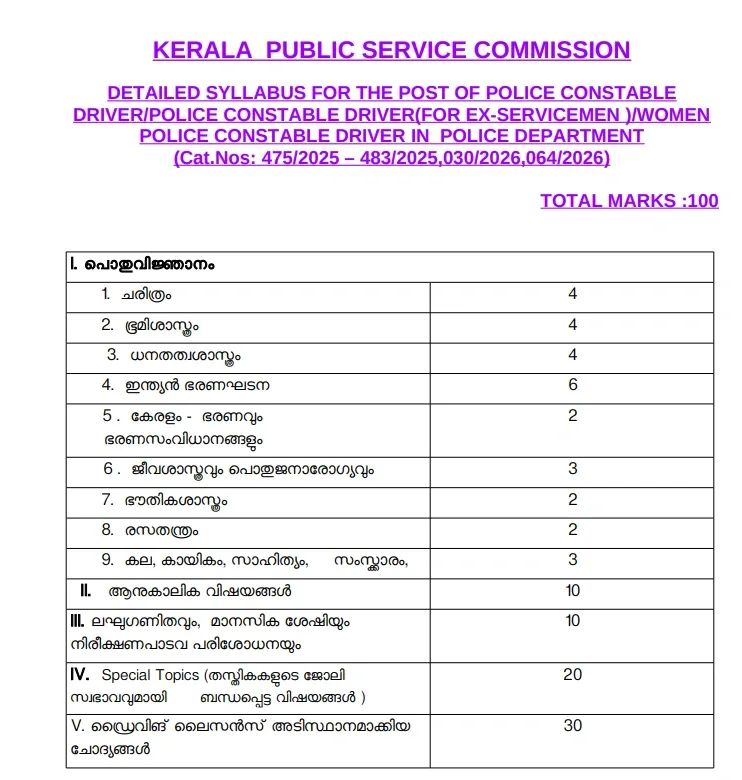
Kerala PSC Police Constable Driver Syllabus 2026 Section Wise
KERALA PUBLIC SERVICE COMMISSION
DETAILED SYLLABUS FOR THE POST OF POLICE CONSTABLE DRIVER / POLICE CONSTABLE DRIVER (FOR EX-SERVICEMEN) / WOMEN POLICE CONSTABLE DRIVER IN POLICE DEPARTMENT
Cat. Nos.: 475/2025 – 483/2025, 030/2026, 064/2026
TOTAL MARKS: 100
I. GENERAL KNOWLEDGE – 30 MARKS
1. HISTORY – 4 MARKS
Kerala
- Arrival of Europeans in Kerala
- Contributions of Europeans
- History of Travancore from Marthanda Varma to Sree Chithira Thirunal
- Social, religious and renaissance movements
- National movements in Kerala
- Literary sources of Kerala history
- Aikya Kerala Movement
- Socio-political history of Kerala after 1956
India
- Political history
- British rule
- First War of Independence
- Formation of the Indian National Congress
- Swadeshi Movement
- Social reform movements
- Newspapers
- Literature and art during the freedom struggle
- Freedom struggle and Mahatma Gandhi
- Post-independence period of India
- Reorganisation of States
- Progress in science, education and technology
- Foreign policy
World
- Glorious Revolution in England
- American War of Independence
- French Revolution
- Russian Revolution
- Chinese Revolution
- Political history after the Second World War
- United Nations
- Other international organisations
2. GEOGRAPHY – 4 MARKS
General Geography
- Basic principles of geography
- Structure of the Earth
- Atmosphere
- Rocks
- Geomorphology
- Atmospheric pressure and winds
- Temperature and seasons
- Global issues
- Global warming
- Various types of pollution
- Maps
- Topographical maps
- Symbols
- Remote sensing
- Geographical Information System (GIS)
- Oceans
- Ocean currents
- Continents
- Countries of the world and their characteristics
India
- Physical features
- States and their characteristics
- Northern Mountain Region
- Rivers
- Northern Great Plains
- Peninsular Plateau
- Coastal regions
- Climate
- Natural vegetation
- Agriculture
- Minerals and industries
- Energy resources
- Road, water, rail and air transport systems
Kerala
- Physical features
- Districts and their characteristics
- Rivers
- Climate
- Natural vegetation
- Wildlife
- Agriculture and research institutions
- Minerals and industries
- Energy resources
- Road, water, rail and air transport systems
3. ECONOMICS – 4 MARKS
India
- Economic sector
- Five-Year Plans
- Planning Commission
- NITI Aayog
- New Economic Reforms
- Financial institutions
- Agricultural crops
- Minerals
- Green Revolution
4. INDIAN CONSTITUTION – 6 MARKS
- Constituent Assembly
- Preamble
- Citizenship
- Fundamental Rights
- Directive Principles of State Policy
- Fundamental Duties
- Components of Government
- Important Constitutional Amendments:
- 42nd Amendment
- 44th Amendment
- 52nd Amendment
- 73rd Amendment
- 74th Amendment
- 86th Amendment
- 91st Amendment
- Panchayati Raj
- Constitutional institutions and their duties
- Union List
- State List
- Concurrent List
5. KERALA – ADMINISTRATION AND GOVERNANCE – 2 MARKS
- State Civil Service
- Constitutional institutions
- Various commissions
- Basic information regarding social, economic and commercial planning
- Disaster Management Authority
- Wetland conservation
- Labour and employment
- National rural employment schemes
- Land reforms
- Protection of women, children and senior citizens
- Social welfare
- Social security
6. BIOLOGY AND PUBLIC HEALTH – 3 MARKS
- General knowledge about the human body
- Vitamins and minerals and diseases caused by their deficiency
- Communicable diseases and their causative agents
- Health and welfare activities in Kerala
- Lifestyle diseases
- Basic health knowledge
- Environment and environmental issues
7. PHYSICS – 2 MARKS
- Branches of physics; matter; units; measurements and quantities
- Motion
- Newton's laws of motion
- Third law of motion
- Momentum
- Projectile motion
- Situations where Newton's third law is applied
- ISRO's achievements in space
- Light
- Lenses
- Mirrors
- Numerical problems using the equation r = 2f
- Various phenomena of light
- Rainbow
- Colours of objects
- Electromagnetic spectrum
- IR rays
- UV rays
- X-rays
- Photoelectric effect
- Sound
- Different types of waves
- Speed of light in different media
- Resonance
- Reflection of sound
- Force
- Different types of forces
- Friction
- Uses and disadvantages of friction
- Fluid pressure
- Buoyant force
- Archimedes' principle
- Pascal's law
- Density
- Relative density
- Adhesion and cohesion forces
- Viscous force
- Surface tension
- Gravitation
- Centripetal force
- Centrifugal force
- Escape velocity of satellites
- Mass and weight
- Value of 'g'
- Variation in the value of 'g' at different places on Earth
- Heat
- Temperature
- Different types of thermometers
- Humidity
- Relative humidity
- Work
- Energy
- Power
- Numerical problems on power
- Levers
- Different types of levers
8. CHEMISTRY – 2 MARKS
- Atom
- Molecule
- Different states of matter
- Transformation of matter
- Gas laws
- Avogadro's law
- Elements
- Periodic table
- Metals and non-metals
- Chemical and physical changes
- Chemical reactions
- Ions
- Mixtures
- Compounds
- Metals and non-metals
- Alloys
- Acids and alkalis
- pH value
- Alkaloids
9. ART, SPORTS, LITERATURE AND CULTURE – 3 MARKS
ART
- Major visual and performing arts of Kerala
- Origin, spread and training of these art forms
- Famous places
- Famous institutions
- Famous personalities
- Famous artists
- Famous writers
SPORTS
- Major sportspersons from Kerala, India and the world who have made their mark in sports, their sporting events, achievements and honours received
- Major awards
- Award winners
- Knowledge of the field for which each award is given
- Major trophies
- Related competitions
- Related sporting events
- Major sports
- Number of players participating in each sport
- Important terms related to games and sports
- Olympics
- Basic information
- Major venues/countries
- Famous victories / sportspersons
- Notable performances by India in the Olympics
- Winter Olympics
- Paralympics
- Asian Games, Afro-Asian Games, Commonwealth Games and SAFF Games
- Venues
- Countries
- India's notable performances
- Other important facts
- National Games
- Sports events and competitions
- Players
- Achievements
- National sports / recreational activities of different countries
LITERATURE
- Major literary movements in Malayalam
- First works
- Authors
- Major works belonging to each literary movement and their authors
- Writers
- Pen names
- Pseudonyms
- Characters
- Literary works
- Famous lines
- Works
- Authors
- Beginning of Malayalam journalism
- Pioneers
- Periodicals
- Major awards / honours
- Award-winning writers
- Works
- Malayalis who have received the Jnanpith Award
- Related facts
- Origin and development of Malayalam cinema
- Milestones
- Major contributors
- Malayalam cinema and National Awards
CULTURE
- Major festivals of Kerala
- Places associated with the festivals
- Famous festivals
- Cultural centres and places of worship in Kerala
- Cultural leaders
- Their contributions
II. CURRENT AFFAIRS – 10 MARKS
Questions related to current affairs.
III. SIMPLE ARITHMETIC, MENTAL ABILITY AND OBSERVATION SKILLS – 10 MARKS
1. SIMPLE ARITHMETIC – 5 MARKS
- Numbers and Basic Operations
- Fractions and Decimal Numbers
- Percentage
- Profit and Loss
- Simple Interest and Compound Interest
- Ratio and Proportion
- Time and Distance
- Time and Work
- Average
- Laws of Exponents
- Mensuration – perimeter, area, volume, etc. of geometrical figures
- Progressions
2. MENTAL ABILITY AND OBSERVATION SKILLS – 5 MARKS
- Series
- Number series
- Letter series
- Problems on Mathematical Signs
- Position / Location Determination Test
- Analogy
- Word Analogy
- Alphabet Analogy
- Number Analogy
- Odd Man Out
- Numerical Ability Problems
- Coding and Decoding
- Family Relations
- Sense of Direction
- Time and Angles in a Clock
- Time in a Clock and its Reflection
- Date and Calendar
- Clerical Ability
IV. SPECIAL TOPICS – 20 MARKS
PART I – 4 MARKS
THE BHARATIYA NYAYA SANHITA, 2023
DEFINITIONS & GENERAL EXPLANATIONS
Sections – Words, Expressions & Explanations
- Section 2(3) – Child
- Section 2(4) – Counterfeit
- Section 2(8) – Document
- Section 2(13) – Harbour
- Section 2(14) – Injury
- Section 2(28) – Public servant
- Section 3(5) – Acts done by several persons in furtherance of common intention
PUNISHMENTS
- Sections 4 & 11 – Punishments
GENERAL EXCEPTIONS
- Sections 14 & 17 – Mistake of fact
- Sections 15 & 16 – Judicial acts
- Section 18 – Accident
- Section 19 – Necessity
- Sections 20 & 21 – Infancy
- Section 22 – Insanity
- Sections 23 & 24 – Intoxication
- Sections 25–30 – Consent
- Section 31 – Communication made in good faith
- Section 32 – Compulsion
- Section 33 – Trifles / slight harm
- Sections 34–44 – Private defence
OFFENCES AGAINST WOMAN AND CHILD
Sections – Offences & Punishments
- Sections 63–66 – Rape
- Section 67 – Sexual intercourse by husband upon his wife during separation
- Section 68 – Sexual intercourse by a person in authority
- Section 69 – Sexual intercourse by deceitful means
- Section 70 – Gang rape
- Section 71 – Repeat offences
- Section 72 – Disclosure of identity of victims
- Section 74 – Outraging modesty of woman
- Section 75 – Sexual harassment
- Section 76 – Disrobing
- Section 77 – Voyeurism
- Section 78 – Stalking
- Section 79 – Insult to modesty of woman
- Section 80 – Dowry death
- Section 81 – Mock marriage
- Section 82 – Bigamy
- Section 83 – Fraudulent marriage ceremony without lawful marriage
- Section 84 – Enticing, taking away or detaining a married woman with criminal intent
- Sections 85 & 86 – Cruelty by husband or relatives
- Section 87 – Kidnapping, etc. of a woman to compel marriage
- Sections 88–90 – Causing miscarriage
- Section 93 – Exposure or abandonment of child
- Section 94 – Secret disposal of child's dead body
- Section 95 – Hiring, etc. of child to commit an offence
- Section 96 – Procuration of child
- Section 97 – Kidnapping or abducting child
- Sections 98 & 99 – Selling/buying child for the purpose of prostitution
OFFENCES AFFECTING THE HUMAN BODY
Sections – Offences & Punishments
- Sections 100 & 105 – Culpable homicide
- Sections 101 & 103 – Murder
- Section 102 – Causing death of a person other than the person whose death was intended
- Section 103(2) – Mob lynching
- Section 104 – Murder by life convict
- Section 106 – Causing death by negligence
- Sections 107 & 108 – Abetment of suicide
- Section 109 – Attempt to murder
- Section 110 – Attempt to commit culpable homicide
- Section 111 – Organised crime
- Section 112 – Petty organised crime
- Section 113 – Terrorist acts
- Sections 114 & 115 – Hurt
- Sections 116 & 117 – Grievous hurt
- Section 118 – Causing hurt by dangerous weapons/means
- Section 119 – Causing hurt to extort property or to constrain an illegal act
- Section 120 – Causing hurt to extort confession or to compel restoration of property
- Section 121 – Causing hurt to deter public servant from duty
- Section 124 – Causing grievous hurt by use of acid, etc.
- Section 125 – Acts endangering life or safety of others
- Section 126 – Wrongful restraint
- Section 127 – Wrongful confinement
- Section 129 – Criminal force
- Section 130 – Assault
- Section 137 – Kidnapping
- Section 138 – Abduction
- Section 143 – Trafficking of persons
- Section 145 – Habitual dealing in slaves
- Section 146 – Unlawful compulsory labour
OFFENCES AGAINST PUBLIC TRANQUILLITY
- Section 189 – Unlawful assembly
- Section 191 – Rioting
- Section 194 – Affray
- Section 195 – Assaulting/obstructing public servant when suppressing riot, etc.
- Section 196 – Promoting enmity between different groups
- Section 197 – Imputations, assertions prejudicial to national integration
OFFENCES BY OR RELATING TO PUBLIC SERVANTS
- Section 198 – Disobeying law, with intent to cause injury to any person
- Section 199 – Disobeying direction under law
- Section 200 – Non-treatment of victim
- Section 201 – Framing an incorrect document with intent to cause injury
- Section 202 – Unlawfully engaging in trade
- Section 203 – Unlawfully buying or bidding for property
- Section 204 – Personating a public servant
- Section 205 – Wearing garb or carrying token used by public servant fraudulently
OFFENCES AGAINST PROPERTY
- Section 303 – Theft
- Section 304 – Snatching
- Section 308 – Extortion
- Section 309 – Robbery
- Section 310 – Dacoity
- Section 314 – Dishonest misappropriation of property
- Section 316 – Criminal breach of trust
- Section 317 – Stolen property
- Section 318 – Cheating
- Section 319 – Cheating by personation
- Sections 324–328 – Mischief
- Section 329 – Criminal trespass and house trespass
- Section 330 – House trespass and house breaking
PART II – 3 MARKS
THE BHARATIYA NAGARIK SURAKSHA SANHITA, 2023
DEFINITIONS
Sections – Words & Expressions
- Section 2(a) – Audio-video electronic means
- Section 2(c) – Bailable and non-bailable offences
- Section 2(g) – Cognizable offence
- Section 2(h) – Complaint
- Section 2(k) – Inquiry
- Section 2(l) – Investigation
- Section 2(o) – Non-cognizable offence
- Section 2(x) – Summons case
- Section 2(y) – Victim
- Section 2(z) – Warrant case
POWERS OF SUPERIOR OFFICERS OF POLICE AND AID TO THE MAGISTRATES AND THE POLICE
- Section 30 – Powers of superior officers of police
- Section 31 – Public when to assist Magistrates and police
- Section 32 – Aid to person, other than police officer, executing warrant
- Section 33 – Public to give information of certain offences
- Section 34 – Duty of officers employed in connection with the affairs of village
ARREST OF PERSONS
- Section 35 – When police may arrest without warrant
- Section 36 – Procedure of arrest and duties of officer making arrest
- Section 37 – Designated police officer
- Section 38 – Right of arrested person to meet an advocate of his choice during interrogation
- Section 39 – Arrest on refusal to give name and residence
- Section 40 – Arrest by private person and procedure on such arrest
- Section 41 – Arrest by Magistrate
- Section 42 – Protection of members of the Armed Forces from arrest
- Section 43 – Arrest how made
- Section 44 – Search of place entered by person sought to be arrested
- Section 45 – Pursuit of offenders into other jurisdictions
- Section 46 – No unnecessary restraint
- Section 47 – Person arrested to be informed of grounds of arrest and of right to bail
- Section 48 – Obligation of person making arrest to inform about the arrest, etc., to relative or friend
- Section 49 – Search of arrested person
- Section 50 – Power to seize offensive weapons
- Section 51 – Examination of accused by medical practitioner at the request of police officer
- Section 52 – Examination of person accused of rape by medical practitioner
- Section 53 – Examination of arrested person by medical practitioner
- Section 54 – Identification of person arrested
- Section 55 – Procedure when police officer deputes subordinate to arrest without warrant
- Section 56 – Health and safety of arrested person
- Section 57 – Person arrested to be taken before Magistrate or officer in charge of police station
- Section 58 – Person arrested not to be detained more than twenty-four hours
- Section 59 – Police to report apprehensions
- Section 60 – Discharge of person apprehended
- Section 61 – Power, on escape, to pursue and retake
SUMMONS AND WARRANT
- Section 63 – Form of summons
- Section 64 – Summons how served
- Section 65 – Service of summons on corporate bodies
- Section 66 – Service when persons summoned cannot be found
- Section 67 – Procedure when service cannot be effected as before provided
- Section 68 – Service on Government servant
- Section 69 – Service of summons outside local limits
- Section 70 – Proof of service in such cases and when serving officer not present
- Section 72 – Form of warrant of arrest and duration
- Section 73 – Power to direct security to be taken
- Section 74 – Warrants to whom directed
- Section 75 – Warrant may be directed to any person
- Section 76 – Warrant directed to police officer
- Section 77 – Notification of substance of warrant
- Section 78 – Person arrested to be brought before Court
- Section 79 – Where warrant may be executed
- Section 80 – Warrant forwarded for execution outside jurisdiction
- Section 81 – Warrant directed to police officer for execution outside jurisdiction
- Section 82 – Procedure on arrest of person against whom warrant issued
SEARCH AND SEIZURE
- Section 96 – When search-warrant may be issued
- Section 97 – Search of place suspected to contain stolen property, forged documents, etc.
- Section 98 – Power to declare certain publications forfeited and to issue search-warrants
- Section 100 – Search for persons wrongfully confined
- Sections 102–104 – General provisions relating to searches
- Section 105 – Recording of search and seizure through audio-video electronic means
- Section 106 – Power of police officer to seize certain property
- Section 107 – Attachment, forfeiture or restoration
- Section 108 – Magistrate may direct search in his presence
- Section 109 – Power to impound document, etc., produced
- Section 110 – Reciprocal arrangements regarding processes
MAINTENANCE OF PUBLIC ORDER AND TRANQUILLITY
- Section 148 – Dispersal of assembly by use of civil force
- Section 149 – Use of armed forces to disperse assembly
- Section 150 – Power of certain armed force officers
- Section 151 – Protection against prosecution for acts done
PREVENTIVE ACTION OF THE POLICE
- Section 168 – Police to prevent cognizable offences
- Section 169 – Information of design to commit cognizable offences
- Section 170 – Arrest to prevent the commission of cognizable offences
- Section 171 – Prevention of injury to public property
- Section 172 – Persons bound to conform to lawful directions of police
INFORMATION TO THE POLICE AND THEIR POWERS TO INVESTIGATE
- Section 173 – Information in cognizable cases
- Section 174 – Information as to non-cognizable cases and investigation of such cases
- Section 175 – Police officer's power to investigate cognizable case
- Section 176 – Procedure for investigation
- Section 177 – Report how submitted
- Section 178 – Power to hold investigation or preliminary inquiry
- Section 179 – Police officer's power to require attendance of witnesses
- Section 180 – Examination of witnesses by police
- Section 181 – Statements to police and use thereof
- Section 182 – No inducement to be offered
- Section 183 – Recording of confessions and statements
- Section 184 – Medical examination of the victim of rape
- Section 185 – Search by police officer
- Section 186 – When officer in charge of police station may require another to issue search-warrant
- Section 187 – Procedure when investigation cannot be completed in twenty-four hours
- Section 188 – Report of investigation by subordinate police officer
- Section 189 – Release of accused when evidence deficient
- Section 190 – Cases to be sent to Magistrate, when evidence is sufficient
- Section 191 – Complainant and witnesses not to be required to accompany police officer and not to be subjected to restraint
- Section 192 – Diary of proceedings in investigation
- Section 193 – Report of police officer on completion of investigation
- Section 194 – Police to enquire and report on suicide, etc.
- Section 195 – Power to summon persons
- Section 196 – Inquiry by Magistrate into cause of death
PART III – 2 MARKS
THE BHARATIYA SAKSHYA ADHINIYAM, 2023
DEFINITIONS
- Section 2(d) – Document
- Section 2(e) – Evidence
- Section 2(f) – Fact
- Section 2(g) – Facts in issue
- Section 2(k) – Relevant
CONFESSION
- Section 22 – Confession by inducement, threat or promise
- Section 23 – Confession to police officer
- Section 24 – Confession of the co-accused
STATEMENTS BY PERSONS WHO CANNOT BE CALLED AS WITNESSES
- Section 26 – Cases in which statement of relevant fact by person who is dead or cannot be found, etc., is relevant
- Section 27 – Relevancy of certain evidence for proving, in subsequent proceeding, the truth of facts therein stated
- Section 28 – Entries in books of account when relevant
- Section 29 – Relevancy of entry in public record or an electronic record made in performance of duty
- Section 30 – Relevancy of statements in maps, charts and plans
- Section 31 – Relevancy of statement as to fact of public nature contained in certain Acts or notifications
- Section 32 – Relevancy of statements as to any law contained in law-books including electronic or digital form
OPINIONS OF THIRD PERSONS WHEN RELEVANT
- Section 39 – Opinions of experts
- Section 40 – Facts bearing upon opinions of experts
- Section 41 – Opinion as to handwriting and signature
- Section 42 – Opinion as to existence of custom or right
- Section 43 – Opinion as to usages, tenets, etc.
- Section 44 – Opinion on relationship
- Section 45 – Grounds of opinion, when relevant
PART IV
1. KERALA POLICE ACT, 2011 – 3 MARKS
- Section 1 – Short title, extent and commencement
- Section 3 – General duties of police
- Section 4 – Functions of the police
- Section 7 – Citizens have the right to efficient police service
- Section 8 – Right of the public at police stations
- Section 14 – Kerala Police
- Section 21 – Special wings, units and squads
- Section 29 – Behaviour of police officers
- Section 31 – Police to keep information confidential
- Section 33 – Police and public may keep audio, video or electronic records
- Section 37 – Entry in private places
- Section 38 – Police to interfere for preventing offence
- Section 39 – Lawful directions of police to be complied with
- Section 57 – Police to attempt to locate missing persons
- Section 61 – Police to regulate and control traffic
- Section 64 – Community policing
- Section 69 – Action on the occasion of fire, disaster or accident
- Section 77 – Regulating nuisance caused by noise
- Section 98 – Special Police Officers
- Section 117 – Penalty for interfering in the functions of the police
- Section 118 – Penalty for causing grave violation of public order or danger
- Section 119 – Punishment for atrocities against women
- Section 120 – Penalty for causing nuisance and violation of public order
2. THE NARCOTIC DRUGS AND PSYCHOTROPIC SUBSTANCES ACT, 1985 – 2 MARKS
Chapter I
- Short title, extent and commencement
Chapter IV
- Offences and penalties
- Section 25 – Punishment for allowing premises, etc., to be used for commission of an offence
- Section 27 – Punishment for consumption of narcotic drug or psychotropic substances
- Section 28 – Punishment for attempt to commit offences
- Section 31A – Death penalty for certain offences after previous conviction
- Section 37 – Offences to be cognizable and non-bailable
Chapter VA
- Forfeiture of illegally acquired property
- Section 68F – Seizure or freezing of illegally acquired property
3. THE PROTECTION OF CHILDREN FROM SEXUAL OFFENCES ACT, 2012 – 2 MARKS
- Section 1 – Short title, extent and commencement
- Section 3 – Penetrative sexual assault
- Section 4 – Punishment for penetrative sexual assault
- Section 7 – Sexual assault
- Section 8 – Punishment for sexual assault
- Section 11 – Sexual harassment
- Section 12 – Punishment for sexual harassment
- Section 16 – Abetment of an offence
- Section 22 – Punishment for false complaint or false information
- Section 23 – Procedure for media
4. THE INFORMATION TECHNOLOGY ACT – 2 MARKS
- Section 43 – Penalty and compensation for damage to computer, computer system, etc.
- Section 43A – Compensation for failure to protect data
- Section 65 – Tampering with computer source documents
- Section 66 – Computer-related offences
- Section 66B – Punishment for dishonestly receiving stolen computer resource or communication device
- Section 66C – Punishment for identity theft
- Section 66D – Punishment for cheating by personation by using computer resources
- Section 66E – Punishment for violation of privacy
- Section 66F – Punishment for cyber terrorism
- Section 67 – Punishment for publishing or transmitting obscene material in electronic form
- Section 67A – Punishment for publishing or transmitting material containing sexually explicit act, etc., in electronic form
- Section 67B – Punishment for publishing or transmitting material depicting children in sexually explicit act, etc., in electronic form
- Section 72 – Penalty for breach of confidentiality and privacy
- Section 77B – Offences with 3 years imprisonment to be bailable
5. THE RIGHT TO INFORMATION ACT, 2005 – 2 MARKS
- Section 2(f) – Information
- Section 8 – Exemption from disclosure of information
- Section 9 – Grounds for rejection to access
- Section 11 – Third-party information
V. QUESTIONS BASED ON DRIVING LICENCE – 30 MARKS
1. DRIVING LICENCE RELATED REGULATIONS – 5 MARKS
Motor Vehicles Act, 1988 – Chapters I & II
Central Motor Vehicle Rules, 1989 – Chapters I & II (except Rule 31)
Kerala Motor Vehicles Rules, 1989
1. Knowledge of definitions under MV Act 1988, CMVR 1989 and KMVR 1989 – 1 MARK
Definitions such as:
- Articulated vehicles
- Certificate of Registration
- Golden Hour
- Public place
- Transport vehicles
- Gross vehicle weight
- Heavy goods vehicles
- Heavy passenger motor vehicles
- etc.
2. Definitions of Vehicle Categories – 1 MARK
Knowledge and distinction of the definitions of Category M, N and T types of vehicles described under CMVR Rule 3 and Rules 2(c), 2(i), 2(w).
3. Motor Vehicles Act, 1988 – 1 MARK
Questions to test knowledge of Sections 3, 4, 5, 6, 10, 14, 15, 18, 20, 21 and 23.
4. Central Motor Vehicle Rules, 1989 – 1 MARK
Questions from Rules 3, 4, 5, 9, 15(3), 16, 17A, 18, 21, 22, 26 and 32.
5. Kerala Motor Vehicles Rules, 1989 – 1 MARK
Questions from Rules 4, 6, 19, 20, 28, 38, 40, 41, 44, 45 and 46.
2. DRIVERS' BADGE RELATED QUESTIONS AND MOTOR VEHICLE DRIVING REGULATIONS, 2017 – 5 MARKS
A. Transport Vehicle Drivers' Badge Questions – 2 MARKS
- Meaning of public service vehicles
- Types of public service vehicles
- Types and validity of permits, such as:
- Contract Carriage
- Goods
- Hazardous Goods
- Stage Carriage
- Temporary Permit
- Special Permit
- etc.
- Validity of fitness certificate of vehicles with respect to:
- Age
- Seating capacity
B. Motor Vehicle Driving Regulations, 2017 – 3 MARKS
- Regulations 3 to 10
- Regulations 11 to 26
- Regulations 27 to 40
3. BASIC KNOWLEDGE OF AUTOMOBILE ENGINEERING – 5 MARKS
With respect to Central Motor Vehicle Rules, 1989, Rule 31
CMV Rule 31A – Driving Theory
- Foot, hand and other controls
- Pre-driving checks
- Beginning to drive
- Driving on the road
- Driving at intersections
- Reversing
- Parking
Drivers' Responsibilities on Roads
- Responsibilities of drivers on roads
Priority of Certain Vehicles
- Priority given to certain vehicles
Driving Skills and Techniques
- Introduction to dial gauges and controls
- Development of judgement and anticipation
- Cross-country driving
- Hill driving
Qualities of a Good Driver
- Qualities of a good driver
- Holding steering wheels
- MSM and PSL
- Types of stopping:
- Emergency
- Normal
- Use of engine brake
- Use of exhaust brake
- etc.
4. OFFENCES UNDER MOTOR VEHICLES ACT, 1988 – 5 MARKS
Section 112 – Limits of Speed
- Limits of speed on various roads as per the latest Government Order
- S.R.O. No. 707/2023
- G.O.(P) No.15/2023/Tran. dated 23/06/2023
Sections 113, 114 & 115
- Limits of weight and limitation of use
- Powers relating to weight
- Power to have the vehicle weighed
Sections 130–134
- Duty to produce licences
- Precautions to be taken
- Duty to stop
- Duty to give information
- Duties while involved in an accident
Sections 177–201 – General Offences and Penalties
Topics include:
- General offences and penalties
- Penalty for violation of Motor Vehicle Driving Regulations, 2017
- Minimum fine by court
- Disobedience
- Driving of vehicle by unauthorised person
- Excessive speed
- Dangerous driving
- Red light jumping
- Drunken driving
- Abatement of offences
- Using a vehicle in an unsafe condition
- Driving without registration
- Driving without permit
- Driving without insurance
- Carrying excess load
- Carrying excess passengers
- Use of seat belts
- Failure to allow free passage of emergency vehicles
- Use of horns
- Silence zones
- Offences by juveniles
- Penalty for causing obstruction to free flow of traffic
5. GOOD SAMARITAN & DETENTION OF DOCUMENTS AND VEHICLES UNDER MOTOR VEHICLES ACT – 5 MARKS
Good Samaritan
- CMVR 1989, Rule 168 – Examination of Good Samaritan
- CMVR 1989, Rule 169 – Examination of Good Samaritan
Detention / Impounding of Documents and Vehicles
- MV Act 1988, Section 206 – Power of police and other officers to impound documents
- MV Act 1988, Section 207 – Power to detain/impound vehicles
CMVR Rules
- Rule 138
- Rule 138A
- Rule 138B
- Rule 139
- Rule 139A
- Rules 167–169
Topics include:
- Signals and additional safety measures
- FASTag
- Carriage of goods in motor vehicles
- Production of driving licence and Certificate of Registration
- Production of documents in electronic form
- E-challan
- Procedure for issuing and paying E-challan
6. CHAPTER V, PART 3 – CONSTRUCTION, EQUIPMENT AND MAINTENANCE OF MOTOR VEHICLES – 5 MARKS
CMVR Rules 117 to 137
Safety Devices and Special Provisions
Rules 117–122
- Speedometer
- Speed governors
- Horns
- Silencers
- Painting of motor vehicles
Rules 123–125
- Safety devices in motorcycles
- Safety belts
- Collapsible steering
- Special requirements for transport vehicles driven on hills
- Safety requirements of all vehicles
- Exemptions for armoured vehicles
Transportation of Goods and Dangerous/Hazardous Materials
Rules 129–136
- Transportation of goods of dangerous or hazardous nature to human life
- Spark arrester
- Manner of display of class labels
- Emergency information panel
- Instructions to the driver
- Driver's report to the police station
Download the CC Learning App today and start your Kerala PSC Police Constable Driver Exam 2026 preparation with the right study resources and guidance!
Join Now!
How to Prepare for Kerala PSC Police Constable Driver Exam 2026?
A practical preparation strategy for Kerala PSC Police Constable Driver Exam 2026 should give priority to the sections with higher marks. Candidates can follow this approach:
- Start with the official Kerala PSC Police Constable Driver syllabus 2026.
- Give dedicated study time to driving licence-based questions.
- Complete the Special Topics section systematically.
- Revise Kerala and Indian General Knowledge.
- Follow current affairs regularly.
- Practice arithmetic, mental ability and observation questions.
- Solve previous PSC questions to understand question patterns.
- Take mock tests to improve speed and accuracy.
- Revise the complete syllabus multiple times before the examination.
Read More at:
- Kerala PSC Police Constable Driver Shortlist 2026 | Category No. 544/2024 : Download PDF
- Kerala PSC Police Constable Driver (Ex-Servicemen) Recruitment Notification 2025 Released | Vacancy, Eligibility & Apply Now!
- Kerala Police Constable Driver Notification 2024 Cat. No. 427/2024 is Out. Apply Online
Prepare for Kerala PSC Police Constable Driver Exam 2026 with CC Learning App
Preparing for the Kerala PSC Police Constable Driver Exam 2026 becomes easier with structured study and regular practice. The CC Learning App, a multi-learning platform for Kerala PSC and competitive exam preparation, provides focused learning resources to help candidates cover the syllabus, revise important topics, practise previous questions and improve performance through mock tests.
With dedicated preparation for General Knowledge, Current Affairs, Mental Ability, Special Topics and Driving Licence-Based Questions, candidates can follow a systematic approach instead of studying scattered materials.
Download the CC Learning App today and start your Kerala PSC Police Constable Driver Exam 2026 preparation with the right study resources and guidance.
Kerala PSC Police Constable Driver Frequently Asked Questions
What is the Kerala PSC Police Constable Driver syllabus 2026?
The Kerala PSC Police Constable Driver syllabus 2026 includes General Knowledge, Current Affairs, Simple Arithmetic, Mental Ability and Observation Skill, Special Topics related to the post, and Driving Licence-Based Questions.
How many marks is the Kerala PSC Police Constable Driver exam 2026?
The prescribed Kerala PSC Police Constable Driver syllabus 2026 carries a total of 100 marks.
Which section has the highest weightage in the Police Constable Driver syllabus 2026?
Driving Licence-Based Questions carry 30 marks, while General Knowledge also carries 30 marks. Special Topics carry 20 marks.
Is driving-related knowledge included in the Kerala PSC Police Constable Driver syllabus?
Yes. Driving Licence-Based Questions form a separate 30-mark section in the official syllabus.
How should I prepare for the Kerala PSC Police Constable Driver exam 2026?
Candidates should combine General Knowledge and Current Affairs preparation with focused study of Special Topics and driving licence-based questions. Regular previous-question practice and mock tests can further improve exam readiness.
Notifications
Trending Updates



Related Blogs
January 28, 2026
Kerala PSC Police Constable Driver Shortlist 2026 | Category No. 544/2024 : Download PDF
4 minute read
August 25, 2026
Kerala PSC Police Constable Driver Exam Date 2026 | Submit Confirmation for Category 030/2026
6 minute read
March 26, 2026