
Table of Contents
The Kerala PSC Junior Lab Assistant Syllabus 2026 is very important for candidates preparing for the Junior Lab Assistant exam 2026 conducted by the Kerala Public Service Commission.
Understanding the Junior Lab Assistant Kerala PSC Syllabus early will help you plan your preparation effectively and score higher in the written Junior Lab Assistant exam 2026.
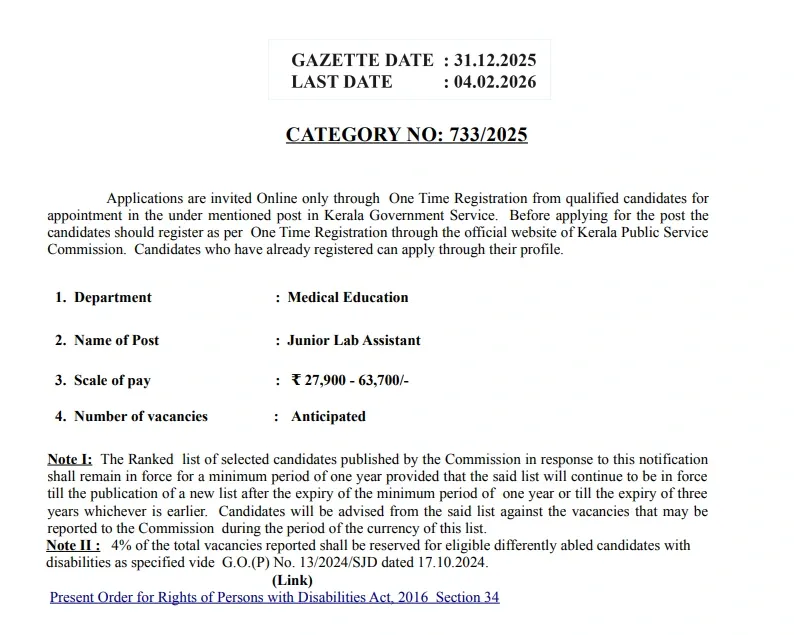
The Kerala PSC Junior Lab Assistant Syllabus 2026 mainly focuses on basic laboratory science, chemistry, physics, botany, zoology, micro biology, and lab techniques, along with general awareness. The Kerala PSC conducts the Junior Lab Assistant exam 2026 as a written objective test (OMR based).
Join CC Learning App to Start Your Kerala PSC Lab Assistant Preparation 2026!
Enrol Today!
Kerala PSC Junior Lab Assistant Syllabus PDF Download
Candidates should always refer to the official Kerala PSC Junior Lab Assistant Syllabus PDF released by Kerala PSC before starting your preparations for Jr Lab Assistant Exam 2026.
Click Here for Kerala PSC Junior Lab Assistant Syllabus PDF Download
DETAILED SYLLABUS FOR THE POST OF JUNIOR LABORATORY
ASSISTANT IN MEDICAL EDUCATION
(Cat.No.: 733/2025) (Total Marks - 100)
PART I : MLT (50 Marks)
MODULE I – 10 Marks
BASIC LABORATORY TECHNIQUES:
- Knowledge of Laboratory chemicals- hazard symbols, warning symbols, safety precautions and storage of chemicals
- Cleaning of glassware – general glass wares, new glass wares, blood- stained pipettes, slides, culture plates etc.
- Cleaning and disinfection of Disinfectants used and biosafety precautions in case of specimen spillage
- Bio- medical waste management -categories of bio-medical waste. Bio- medical waste – color coding, types of containers, collection, transport and disposal of biomedical waste.
- Basic first aid techniques for cuts & bruises, burn injury etc.
- Sample collection and processing – barcoding, safety precautions, processing of samples etc.
- Common Instruments used in laboratories – incubators, centrifuge, semi autoanalyzer, Colorimeter, Micropipettes etc
- Distillation and deionisation apparatus and use Laboratory management system
MODULE II- 13 Marks
BLOOD AND PHLEBOTOMY - 10 Marks
- Methods of blood collection –
- Capillary Puncture
- Arterial puncture and venous puncture
- Vacutainer – colour codes for vials
- Sites of blood collection: Capillary and Venous.
- Anticoagulants used – advantages and disadvantages
- Identification of blood cells: Leishman's staining procedure & identification
- Blood cell types: RBC, WBC, Platelets (Identifying characters and Normal Range)
HEMATOLOGY
- Heamocytometry Counting chamber : improved Neubauer
- Total cell counts: RBC, WBC, Platelet, Absolute Eosinophil count. (Diluting fluids, Normal value, Clinical Significance),
- Reticulocyte count : Clinical significance
- Hemoglobin estimation : Enumerate methods ,WHO recognized method : cyanmethhaemoglobin method, significance.
- PCV – Methods, Wintrobe 's method, Normal value clinical significance.
- ESR- Method (westergren's method), Normal value, Clinical Significance.
- Test for coagulation: Bleeding time methods & Normal value of Duke's method.
- Clotting time methods & Normal value of Capillary tube method
- Automation- Heamotology analyser, Haemogram, CBC – principle
BLOOD BANKING AND IMMUNO HAEMOTOLOGY – 3 Marks
- Blood group antigens and antibodies.
- Blood group system. (ABO and Rh system in detail,)
- Blood grouping techniques.
- Cell grouping and Serum grouping.
- Slide and tube method
Transfusion phlebotomy
- Donor screening, Donor selection criteria.
- Blood bank-Anticoagulants
- Compatibility testing and issue of blood.
- Cross matching-Minor and Major. Mention 3 phases.
MODULE III – 15 Marks
CLINICAL PATHOLOGY - 5 Marks
Analysis of Urine, Sputum, Stool, Semen, CSF -Types of sample, collection of sample, Physical, Chemical & Microscopic examination techniques & their Importance
BIOCHEMISTRY
Blood Glucose estimation
- Types of samples: FBS, PPBS ,RBS
- Methods of estimation – enzymatic method and glucometer (dry chemistry) Normal value,
- Clinical significance,
- Relevance of HbAlc
Renal function test
- Enumerate the common test included.
- Common method used for the estimation of Blood urea, Serum creatinine (normal values). Clearance test (Urea & Creatinine)
Liver function test
- Common tests included. Method used for estimation of Bilirubin (Malloy and Evelyn method)
- Lipid profile Tests included in lipid profile
- Common method for the estimation of cholesterol.
Other parameters of Diagnostic importance.
- Serum electrolytes: Sodium, Potassium. Normal value and Clinical significance.
- Name cardiac Markers.
- Name Tumor Markers.
- Clinically important hormones & enzymes
Automation in Biochemistry
- Types of analyser, various Assay techniques, POCT etc
MODULE IV- 12 Marks
MICROBIOLOGY – 5 Marks
Classification of bacteria based on Morphology.
Sterilization methods.
- Hot Air Oven, Autoclave (Operation procedure , preparation of articles ,precautions to be taken and use)
- Disinfectants & Antiseptics (Application)
- Culture Media: Classification of culture media with example ( knowledge assessment)
- Culture Methods: Streak, Stroke, Stab, Lawn culture, Anaerobic technique (gaspak) (Knowledge assessment)
Identification of bacteria :
- Different methods .
- Detection of motility : Names of different methods (Hanging Drop Method )
- Staining : (Simple stain, gram stain, AFB stain)- techniques and diagnostic significance.
- Biochemical tests : Oxidase, Coagulase, Catalase, & IMViC
- Serological techniques- Agglutination test- Widal test , Precipitation test- RPR/VDRL, ELISA, PCR
Parasitology – 2 Marks
Laboratory diagnosis of Malaria
- Disease, Mode of transmission, host, causative agent & types of Malaria
- Thick and thin smear preparation – advantages and disadvantages
- Stains used: Leishman, fildes JSB etc
- Other methods : card method , QBC.
Laboratory Diagnosis of Filariasis .
- Disease, mode of transmission, host and nocturnal habit.
- Lab diagnosis : Wet smear examination , thick smear examination, concentration techniques.
Histotechnology and cytology histotechnology : - 5 Marks
Tissue processing (steps of tissue processing), fixation techniques, Histokinette, Microtomes, staining: (H and E stain)
Diagnostic cytology : Types of specimen , Processing , Fixation (fixatives used), Staining, advantages and application of diagnostic cytology
PART II : PHYSICS (15 Marks)
Module I - 4 Marks
Units and Measurements:
System of Units – CGS and S.I System, Multiples & sub multiples of unit, Parallax method– for measurement of large distances, Significant figures, Accuracy and Precision, Errors in measurement and Calculation.
Kinematics – Motion in a straight line and plane.
Graphical representation of motions – Position time graph and velocity time graph, Equation of motion, Displacement and distance, Velocity and acceleration, Vector addition – Triangular law and Parallelogram law, Uniform circular motion – Centripetal force and acceleration.
Dynamics – Laws of motion and Work, Energy & Power.
Newton’s laws of motion, Impulse and its application, Law of conservation of momentum – Recoil of gun, Friction – Laws of static and kinetic friction, angle of repose, Methods of
reducing friction.
Different types of work, Kinetic and Potential energy, Power, Collision -Elastic and Inelastic collision.
System of Particles and Rotational motion & Gravitation
Law of conservation of angular momentum and its application, Torque and Angular momentum, Moment of Inertia of regular bodies – Ring, disc, sphere and Cylinder, Theorem on Moment of Inertia – Parallel axes and Perpendicular axes, Kinetic energy of rolling bodies
Acceleration due to gravity (g) and its variation with depth and height, Orbital velocity and time period of satellite, Escape velocity, Kepler’s third law.
Module II - 3 Marks
Mechanics of Solids and fluids
Elasticity – Stress and strain, Moduli of elasticity -Young, Bulk and rigidity, Stress strain graph, Fluid pressure, Pascal’s law and its applications, Surface tension, Viscosity, Bernoulli’s theorem and its application, Equation of continuity, terminal velocity.
Heat and Thermodynamics
Principle of mixture, Scales of temperature, Specific heat capacity, First and second law of thermodynamics, Isothermal and adiabatic process, Carnot’s Heat engine.
Oscillation & Waves
Simple Harmonic Motion (SHM), simple pendulum, Longitudinal and transverse waves, Vibration in air column – Open pipe and closed pipe, Beats and doppler effect.
Module III - 4 Marks
Electrostatics
Quantization of charge, Coulomb’s law, Electric field, Gauss’s theorem and its application, Equi potential surfaces, Capacitance, Parallel plate capacitor, combination of capacitors -series & Parallel.
Electro dynamics- Current Electricity
Ohm’s law, Electric current and current density, Colour code of resistors, Resistivity and
conductivity, Drift velocity and mobility, Potentiometer.
Moving charges and magnetism
Biot-Savart’s law and its application – circular coil, Solenoid and Toroid, Galvanometer to ammeter and voltmeter, Classification of magnetic materials – dia, para and ferro materials, Magnetic field lines.
Electromagnetic induction & AC
Faraday’s laws, Eddy current and its applications, Self induction, AC generator, Transformers, Wattless current and Q-factor of LCR circuit, Reactance of ac circuits.
Electromagnetic waves
Properties of Electro magnetic waves and its uses, Electromagnetic spectrum.
Module IV - 4 Marks
Ray and Wave optics
Reflection of spherical mirrors, Refraction and its application, Total internal reflection and its applications, Lens maker’s formula, Power of a lens, Combination of lens, Scattering and dispersion, Microscope, Interference -Young’s double slit experiment, Polarisation -Malu’s law and Brewster’s law.
Modern Physics – Dual nature of radiation & matter, Atoms & nuclei
Photo electric effect, Einstein’s Photo electric equation, Matter waves, Bohr atom model -Spectral series of Hydrogen atom, Half life period and nuclear reactor.
Semiconductor physics
Concept of Energy band – Classification of materials – conductor, insulators and semiconductors, Properties of semiconductors, Dopping, Intrinsic and extrinsic semiconductor, N type and P type semiconductors, P N junction diode, Half wave and full wave rectifiers, Zener diode, Photo diode and LED.
PART III : CHEMISTRY (15 Marks)
Module I : Physical Chemistry (5 Marks)
Some basic concepts of chemistry-mole concept calculation, definition of molarity,
molarity calculations.
Structure of atom-Different atom model –Rutherford, Neils Bohr, concepts of
orbitals,quantum number,shape of s,p,and d orbitals, rules for filling electrons in
orbitals
Equilibrium- concept of PH
Electrochemistry-Different types of ,also called voltaic and electrolytic) electrochemical cells(Galvanic Surface chemistry – Colloids and emulsions- type of colloids with examples colloids around us
Module II : Inorganic Chemistry (5 Marks)
Periodic classification of elements- Modern periodic table and the present form of periodic table,periodic trends in properties and their variation along a group and period with reason–atomic radii, electronegativity
Hydrogen – Types of water- Hardness of water-causes of hardness and its removal,Hydrogen peroxide
S-block elements -Biological importance of sodium and calcium
P-Block elements- Allotrops of diamond and Graphite their structure and properties,Compounds of nitrogen –Ammonia and Nitric acid ,compounds of Sulphur, sulphuric acid
Applications of d & f block elements
Module III : Organic Chemistry (5 Marks)
Organic chemistry some Basic principles and techniques- IUPAC nomenclature of organic compounds, Different method used for purification of organic compouds distillation,crystallization,sublimation
Hydrocarbons –General formula of alkanes
Test for alcohols,phenol,aldehydes ,ketones
Alcohol -Isopropyl alcohol,glycerol
Chemistry in Everyday life –Chemistry in food ,medicines (Anticeptic, antibiotic),cleansing agents
Biomolecules-Carbohydrates,proteins,vitamins ,nucleic acids
Polymers-Poly styrene,Polyurethane,Silicones,Poly carbonates,Polyether,Polyester
PART : IV BOTANY (10 marks
MODULE I : CELL STRUCTURE AND FUNCTION ( 2 Marks)
CELL THE UNIT OF LIFE
- Cell Theory
- Prokaryotic and Eukaryotic cells
- Cell organelles - Structure and function.
CELL CYCLE AND CELL DIVISION
- Cell Cycle
- Phases of cell cycle – Interphase , Mitosis , Meiosis .
MODULE II : REPRODUCTION ( 2 Marks)
REPRODUCTION IN ORGANISMS
- Asexual reproduction – Methods
- Vegetative propagules
- Sexual reproduction – Events , Ovipary, Vivipary.
SEXUAL REPRODUCTION IN FLOWERING PLANTS .
- Stamen, Microsporangium, Pollen grain – Structure and development.
- Pistil , Megasporangium ( Ovule ) – Structure and development.
- Pollination , Outbreeding devices
- Artificial hybridisation
- Double fertilization
- Endosperm , Embryo , Seed
- Apomixis , Polymeryonyx.
MODULE III: BIOLOGY IN HUMAN WELFARE ( 1 Mark )
STRATEGIES FOR ENHANCEMENT IN FOOD PRODUCTION .
- Animal husbandry
- Management of farms and farm animals , Animal breeding , Bee keeping , Fisheries
- Plant breeding ,Biofortification
- Single cell protein
- Tissue culture.
MODULE IV : BIOLTECHNOLOGY ( 3 Marks )
BIOTECHNOLOGY PRINCIPLES AND PROCESSES
- Principles of biotechnology
- Tools of recombinant DNA technology
- Separation and isolation of DNA fragments ( Gel electrophoresis )
- Cloning vectors
- Process of recombinant DNA technology – Isolation of DNA,
- Amplification of gene of interest using PCR , Obtaining foreign gene product , Downstreaming process.
BIOTECHNOLOGY AND ITS APPLICATIONS
- Biotechnological applications in agriculture
- Biotechnological applications in medicine
- Transgenic animals
- Ethical issues.
MODULE V : ECOLOGY ( 2 Marks )
ORGANISMS AND POPULATIONS
- Organisms and its environment , Abiotic factors , Response to abiotic factors
- Adaptations
- Populations – Population attributes , Population growth , Life history variation , Population interactions .
ECOSYSTEM
- Ecosystem-Structure and Function
- Productivity
- Decomposition ,
- Energy flow
- Ecological Pyramids
- Ecological Succession – Hydrarch Succession , Xerarch Succession.
- Nutrient cycling.
ENVIRONMENTAL ISSUES
- Pollution – Air , Water
- Greenhouse effect and global warming ,Ozone depletion
- Deforestation , Reforestation
- People’s participation in conservation of forests.
PART V : ZOOLOGY (10 Marks)
MODULE I : HUMAN PHYSIOLOGY (5 marks)
DIGESTION AND ABSORPTION
Parts of Human Digestive system, Mechanism of Carbohydrate, Protein and fat digestion
BREATHING AND EXCHANGE OF GASES
Parts of Human Respiratory system, Mechanism of Breathing in man, Transport of Carbon dioxide and oxygen through blood
BODY FLUIDS AND CIRCULATION
Structure of Human heart, Cardiac cycle, ECG
EXCRETORY PRODUCTS AND THEIR ELIMINATION
Parts of Human kidney, Process of Urine Formation, Hormonal regulation of Kidney
Function
LOCOMOTION AND MOVEMENT
Three types of muscles, Mechanism of muscle Contraction, Human skeleton, Types of
Joints
NEURAL CONTROL AND COORDINATION
Structure of Neuron, Parts of human brain, Structure of Eye and Ear
CHEMICAL COORDINATION AND INTEGRATION
Endocrine glands, hormones and their functions,
HUMAN REPRODUCTION
Structure of Male and Female reproductive system, Gametogenesis, Fertilization, Implantation, Functions of Placenta, Embryonic development,
REPRODUCTIVE HEALTH
Sexually transmitted diseases, Contraceptives, Assisted Reproductive Technologies
MODULE II : GENETICS (2 marks)
HEREDITY AND VARIATION
Non Mendelian inheritance – Co dominance, Multiple alleles, Chromosomal and Mendelian disorders, Sex determination in humans
MOLECULAR BASIS OF INHERITANCE
Structure and functions of DNA, Central Dogma-Transcription and Translation, DNA
Finger printing
MODULE III : BIOLOGY IN HUMAN WELFARE (1 mark)
HUMAN HEALTH AND DISEASES
Types of Immunity, Immune system of human body, Allergy, AIDS, Cancer
Module IV) ANIMAL KINGDOM (2 marks)
Characteristic features and examples of different phyla (Porifera, Coelenterate, Platyhelminthes, Aschelminthes, Annelida, Arthropoda, Mollusca Echinodermata, Chordate)
Related Blogs:
- Kerala PSC Junior Lab Assistant Notification 2026, Cat No. 733/2025: Eligibility, Salary & Apply Online
- Kerala PSC Junior Lab Assistant Selection Process 2026
- Kerala PSC Junior Lab Assistant 2026 Eligibility Criteria
- Kerala PSC Junior Lab Assistant Vacancy 2026
Download the CC Learning App and start your Junior Lab Assistant preparation with confidence.
Download Now!
How to Prepare for Kerala PSC Junior Lab Assistant Exam 2026
To prepare effectively for the Kerala PSC Junior Lab Assistant Exam, candidates should first understand the official syllabus and exam pattern, then focus on concept clarity through organised learning, regular revision, and consistent practice using model and previous question papers.
A smart way to do this is by using the CC Learning App, the best PSC coaching app in Kerala, which offers syllabus-aligned video classes, topic-wise explanations, mock tests, and PSC-oriented practice questions designed specifically for Kerala PSC exams. With expert guidance, flexible app-based learning, and personal guidance, the CC Learning App helps aspirants stay focused and exam-ready.
Download the CC Learning App and start your Junior Lab Assistant preparation with confidence.
FAQs
What is the syllabus of Kerala PSC Junior Lab Assistant?
The Kerala PSC Junior Lab Assistant syllabus includes general science, lab techniques, chemistry, physics, biology, micro biology and others.
What is the Kerala PSC Junior Lab Assistant salary?
The Kerala PSC Junior Lab Assistant salary salary range is ₹27,900–₹63,700 per month.
Where can I get Kerala PSC Junior Lab Assistant syllabus PDF download?
You can download the official Kerala PSC Junior Lab Assistant syllabus PDF directly from the Kerala PSC website or from here.
What is the Junior Lab Assistant exam pattern Kerala PSC follows?
Junior Lab Assistant exam 2026 is an offline OMR-based exam with 100 questions for 100 marks.
Is chemistry important in the Junior Lab Assistant Kerala PSC syllabus?
Yes, basic chemistry concepts related to lab work are important in Junior Lab Assistant exam 2026.
What are the required qualifications for Kerala PSC Junior Lab Assistant 2026?
Required qualifications for Kerala PSC Junior Lab Assistant 2026 include pass in Pre-Degree/Plus Two with Physics, Chemistry & Biology or equivalent VHSE (MLT) qualification.
Notifications
Trending Updates


Related Blogs
January 6, 2026
Kerala PSC Junior Lab Assistant Notification 2026, Cat No. 733/2025: Eligibility, Salary & Apply Online
4 minute read
February 9, 2026
Kerala PSC Junior Lab Assistant 2026 Eligibility Criteria
5 minute read
February 9, 2026