
Table of Contents
The Kerala PSC Junior Clerk Syllabus 2026 is one of the most important resources for candidates preparing for the Kerala PSC Junior Clerk Apex Society Recruitment 2026 (Category No. 90/2026). Understanding the latest exam pattern, subject-wise syllabus, and marks distribution helps aspirants prepare strategically and avoid missing important topics.
Scroll down to get the complete Kerala PSC Junior Clerk Syllabus 2026 PDF, detailed exam pattern, and official subject-wise syllabus for effective preparation.
Kerala PSC Junior Clerk Syllabus 2026 Overview
Candidates preparing for the Kerala PSC Junior Clerk Recruitment 2026 should thoroughly understand the official syllabus before beginning their preparation. The written examination evaluates candidates on Co-operation, Banking, and IT & Cyber Laws, making it essential to cover every prescribed topic systematically. The official Kerala PSC Apex Society Junior Clerk Syllabus 2026 PDF Download also serves as the foundation for planning revision, mock tests, and previous year question practice.
Particular | Details |
Recruitment | |
Post | Apex Society Junior Clerk 2026 |
Category Number | 90/2026 |
Conducting Authority | Kerala Public Service Commission (Kerala PSC) |
Department | Apex Societies of Co-operative Sector in Kerala |
Kerala PSC Junior Clerk Exam Type | OMR Objective Examination |
Kerala PSC Junior Clerk 2026 Total Marks | 100 |
Official Kerala PSC Junior Clerk Syllabus 2026 | Available |
Kerala PSC Official Website |
Kerala PSC Junior Clerk Exam Pattern 2026
The Kerala PSC Junior Clerk Exam Pattern 2026 consists of a single objective-type examination carrying 100 marks. The syllabus is divided into three sections, with the highest weightage given to Co-operation, followed by Banking and IT & Cyber Laws. Candidates should allocate their preparation time according to the marks distribution to maximise their overall score.
Subject | Marks |
Co-operation | 50 |
Banking | 40 |
IT & Cyber Laws | 10 |
Total | 100 |
The official Kerala PSC Apex Society Junior Clerk Syllabus 2026 PDF Download clearly states that, apart from the topics specifically listed, questions from subjects prescribed for the educational qualification of the post may also appear in the examination.
Kerala PSC Junior Clerk Syllabus 2026 PDF Download
Candidates are advised to download the Kerala PSC Junior Clerk Syllabus 2026 PDF and use it as a checklist throughout their preparation. Following the official syllabus helps ensure that every important topic is covered before the examination and enables candidates to prepare according to the latest Kerala PSC pattern.
Click Here for Kerala PSC Junior Clerk Syllabus 2026 PDF Download
Kerala PSC Junior Clerk Syllabus 2026 for Apex Society Recruitment
Category Number: 090/2026
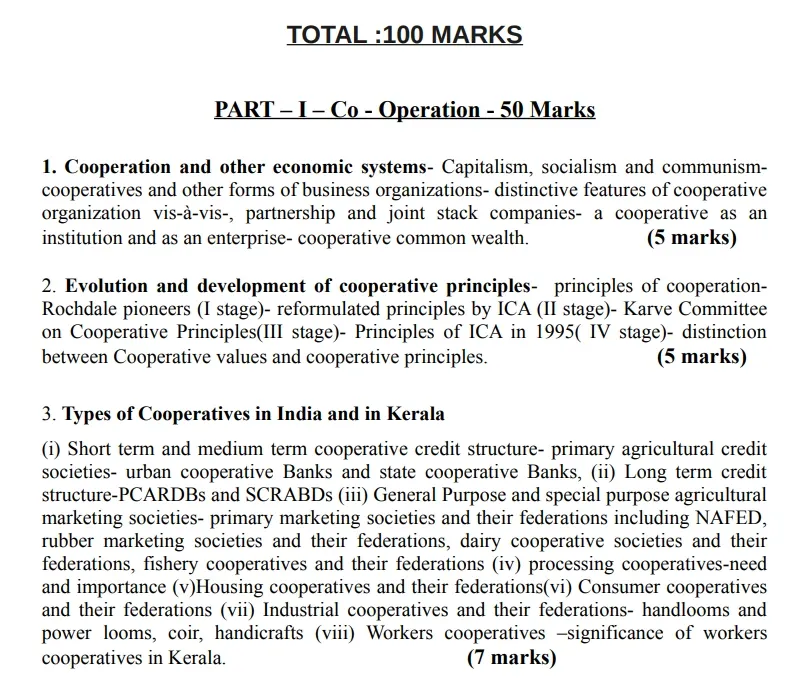
TOTAL :100 MARKS
PART – I – Co - Operation - 50 Marks
1. Cooperation and other economic systems
- Capitalism, socialism and communism cooperatives and other forms of business organizations- distinctive features of cooperative organization vis-à-vis-, partnership and joint stack companies- a cooperative as an institution and as an enterprise- cooperative common wealth. (5 marks)
2. Evolution and development of cooperative principles
- principles of cooperationRochdale pioneers (I stage)- reformulated principles by ICA (II stage)- Karve Committee on Cooperative Principles(III stage)- Principles of ICA in 1995( IV stage)- distinction between Cooperative values and cooperative principles. (5 marks)
3. Types of Cooperatives in India and in Kerala
(i) Short term and medium term cooperative credit structure- primary agricultural credit societies- urban cooperative Banks and state cooperative Banks,
(ii) Long term credit structure-PCARDBs and SCRABDs
(iii) General Purpose and special purpose agricultural marketing societies- primary marketing societies and their federations including NAFED, rubber marketing societies and their federations, dairy cooperative societies and their federations, fishery cooperatives and their federations
(iv) processing cooperatives-need and importance
(v)Housing cooperatives and their federations
(vi) Consumer cooperatives and their federations
(vii) Industrial cooperatives and their federations- handlooms and power looms, coir, handicrafts
(viii) Workers cooperatives –significance of workers cooperatives in Kerala. (7 marks)
4. Management and working of major cooperative organizations and institutions in aid of cooperatives
- NAFED,IFFCO,KRIBCO,NABARD,NDDB,NCDC, and National Housing Bank and other national organizations providing assistance to housing cooperatives. (5 marks)
5. Cooperative audit
- Definition-objectives-scope-advantage-difference between audit of cooperative societies and joint stock companies- special features of cooperative auditadministrative set up for cooperative audit-types of audit-mechanical audit-preparations for audit and framing of audit programme-staged of practical audit- mechanical audit, administrative audit, preparation of final statement- reconciliation of bank accounts- cooperative auditor- duties, powers and liabilities- audit report- audit certificate- audit classification- assessment and levy of audit fees. (6 marks)
6. Issues in cooperative management
- Managing the social process in a cooperative, competition, conflict and cooperation. Associative character of a cooperative and managing a cooperative association. Issues in organizing a cooperative - size of the organization- small area vs large area, single purpose vs multipurpose cooperatives, multipurpose vs multifunctional cooperatives- unitary vs federal cooperatives- designer vs greenhouse cooperatives- issues in financing a cooperative- evaluating a cooperative organization- member dimension, enterprise dimension and ethical dimension. (6 marks)
7. Settlement of disputes
- arbitration and awards- provisions and procedures- execution and enforcement of awards- provisions and procedures, appeals, review and revisionmeaning and distinction- authority of appeals- cooperative tribunal- constitution and powers- offences and penalties- provisions and procedures. (5 marks)
8. Sources of funds
- State aid to cooperatives-share capital contribution- principal state partnership fund- subsidiary state partnership fund- grants- subsidies- owned fundsborrowed funds. (5 marks)
9. Cooperative Legislation in India and in Kerala
- Evolution of cooperative legislation in India- the 1904 Act, the Act of 1912, transfer of cooperation as provincial subject, National development Council Resolution 1956, the Model Cooperative Societies Bill 1957, the Model Cooperative Societies Bill 1991 by Planning Commission- Trend towards parallel Cooperative Laws- Andhra Pradesh Mutually Aided Cooperative Societies Act 1995, Multi State Cooperative Societies Act 1984 and its replacement in 2002.Evolutions of Cooperative legislation in Kerala and enactment of Kerala Cooperative Societies Act 1969. (6 marks)
PART II – Banking – 40 Marks
1. Commercial Banking:
Origin of the word ‘Bank’. Commercial banking system: Unit banking, branch banking, correspondent banking, group banking/ holding company banking, chain banking, mixed banking. Functions of a commercial bank: Primary functions - Accepting of deposits – different types of deposits – savings deposits, current deposits, fixed deposits, recurring deposits, Basic Savings Bank Deposit Account (BSBDA), Current Account Savings Account (CASA), certificate of deposits; Lending of funds – different methods – direct loans, cash credit, overdraft, discounting of bills; Ancillary Services / Subsidiary Functions: Agency services, general utility services. Principles of commercial banking/ Principles of lending. Credit creation by commercial banks: primary deposits and derived deposits, technique of credit creation, credit contraction, limitations of credit creation. (4 marks)
2. Central Banking:
Definition of a central bank, origin of Reserve Bank of India, nationalisation of RBI, functions of RBI – issue of currency, principles and systems of note – issue, RBI as currency authority; RBI as banker, agent, advisor and debt manager to Government, RBI’s financial assistance to Central and State Governments – ways and means advances, overdraft; central bank as bankers’ bank -regulation and supervision of banks by RBI; Reserve Bank as custodian of foreign exchange reserves of the country; developmental role of RBI; Instruments of Monetary Policy : Quantitative techniques of credit control – Bank Rate Policy, operation and limitations of Bank Rate Policy, Open Market Operations (OMO) – objectives, method of operation by RBI, limitations of OMO, Variable Reserve Requirement – Cash Reserve Ratio (CRR) and Statutory Liquidity Ratio (SLR); Qualitative methods of credit control- regulation of consumer credit, variation of margin requirements, moral suasion, rationing of credit. (4 marks)
3. Indian Commercial Banking
- Pre- Liberalisation period: Formation of Imperial Bank of India, Origin of State Bank of India and its associates, merging of associate banks with SBI. Social Control over banks – circumstances leading to social control, aims and objectives of the National Credit Council. Nationalisation of commercial banks. Lead Bank Scheme: Objectives, functions of Lead Bank, District Credit Plan. Concept of Service Area Approach. Differential Rate of Interest Scheme – features of the scheme. Regional Rural Banks – objectives, capital structure and management, problems and progress of RRBs, merging of RRBs. (4 marks)
4. Indian Commercial Banking
– Post Liberalisation: Post liberalisation banking in India – major recommendations of the Narasimham Committee on Financial System, Narasimham Committee on Banking Sector Reforms. Entry of new generation banks. Mergers and acquisitions in the banking sector. Local Area Banks: Features. Differentiated banks: Payment Banks and Small Finance Banks – permitted business. Financial Inclusion: Concept, RBI and NABARD initiatives for financial inclusion. (4 marks)
5. Banking Legislation in India:
Banking Regulation Act, 1949 with latest amendments – objectives, definition of banking, banking company, approved securities, Demand and Time Liabilities (DTL), permitted and prohibited business of a banking company, regulation of voting rights of shareholders, restriction as to payment of dividend, reserve fund, licensing of banking companies, power of inspection, audit of bank accounts, acquisition of banking companies, amalgamation of banking companies, winding up of a banking company. (4 marks)
6. Practices of Banking:
Banker and Customer – general and special relationship between a banker and customer, obligations of banker – honouring of cheques, maintaining secrecy of customers’ accounts, garnishee order, consequences of wrongful dishonor of cheques, stop payment of cheques; rights of a banker- right of general lien, right of set off, banker’s right of appropriation (Clayton’s rule). Banking Ombudsman – objectives, nature of complaints dealt by Ombudsman. Types of customers – operation and closing of different types of bank accounts, special types of bank customers, Accounts of Non Resident Indians; Joint accounts, accounts of partnership firms, joint stock companies, clubs and associations. (4 marks)
7. Law relating to Negotiable Instruments:
Characteristics of negotiability, types and features of negotiable instruments – bill of exchange, promissory notes and cheques. Bank drafts, pay orders. Endorsement of negotiable instruments – legal significance, kinds of endorsements. Crossing of cheques – significance of crossing, types of crossing, marking of cheques. Collecting banker – legal status, statutory protection, duties. Paying Banker – dishonour of cheques, statutory protection, payment in due course, holder and holder in due course. Modes of charging securities – lien, pledge, hypothecation, mortgage – kinds of mortgage; Guarantee and indemnity – rights and duties of guarantor. (4 marks)
8. Agriculture and Micro Finance by banks:
Types of agricultural credit – short term, medium term, long term, crop loans; Kisan Credit Card (KCC) Scheme – Objectives/ purpose, eligibility, features. Lending to priority sectors – categories, targets and sub targets. National Bank for Agriculture and Rural Development (NABARD) – financial, developmental and supervisory role. Micro finance – concept and significance, Linking of Self Help Groups (SHG) and banks. (4 marks)
9. Technological Advances in Banking :
Payment and Settlement System of RBI - Concepts of electronic banking, Electronic Clearing Services (ECS), Real Time Gross Settlement (RTGS), National Electronic Funds Transfer (NEFT), Immediate Payment Service (IMPS), Indian Financial System Code (IFSC), Automated Teller Machine (ATM) card, debit card, credit card, RuPay card, internet banking, mobile banking, digital banking, digital signature, digital certificate, digital wallet, Cash Deposit Machine (CDM), Cheque Truncation System (CTS), cashless payment system, cashless economy; International Payment System - Society for Worldwide Interbank Financial Telecommunication (SWIFT). (4 marks)
10 Recent Trends in Indian Banking:
Credit Rating of banks: CAMELS Rating. Capital Adequacy Ratio – Tier I & Tier II capital, Risk Weighted Assets, Capital to Risk Weighted Assets Ratio (CRAR). Non-Performing Assets (NPA) of banks – Classification of Standard, Substandard, doubtful and loss assets, provisioning for NPAs. Concepts of Securitisation, Reconstruction and Security Interest Enforcement under SARFAESI Act, 2002. Pradhan Mantri Social Security Schemes implemented through banks - Rules for Pradhan Mantri Suraksha Bima Yojana (PMSBY), Pradhan Mantri Jeevan Jyoti Bima Yojana (PMJJBY)’ Atal Pension Yojana (APY).(4 marks)
PART III - IT & CYBER LAWS - 10 Marks
Hardware
- Input Devices (Names and uses)
- Output Devices (Names and uses/features
- Memory devices - Primary and Secondary (Examples, Features)
Software
- Classification – System software and Application software
- Operating System – Functions and examples
- Popular Application software packages – Word processors, Spreadsheets, Database packages, Presentation, Image editors (Uses, features and fundamental concepts of each)
- Basics of programming – Types of instructions (Input, Output, Store, Control transfer) (Languages need not be considered)
Computer Networks
- Types of networks – LAN, WAN, MAN (Features and application area)
- Network Devices – Media, Switch, Hub, Router, Bridge, Gateway (Uses of each)
Internet
- Services – WWW, E-mail, Search engines (Examples and purposes)
- Social Media (Examples and features)
- Web Designing – Browser, HTML (Basics only)
Cyber Crimes and Cyber Laws
- Types of crimes (Awareness level)
- IT Act and Other laws (Awareness level)
Start your Kerala PSC Junior Clerk Preparation 2026 today with the best online PSC coaching platforms in Kerala and prepare confidently for the Apex Society Recruitment examination!
Enrol Today!
Best Preparation Strategy for Kerala PSC Junior Clerk Exam 2026
Preparing for the Kerala PSC Junior Clerk Apex Society Recruitment 2026 requires a proper study plan that covers all three sections of the official syllabus. Since Co-operation carries 50% of the total marks, candidates should give it the highest priority while also allocating sufficient time for Banking and IT & Cyber Laws.
- Complete the Official Syllabus First
- Focus on the Co-operation Section
- Strengthen Banking Concepts Daily
- Revise IT & Cyber Laws Regularly
- Practice Previous Year Question Papers
- Attend Mock Tests
- Revise Every Week
Prepare for Kerala PSC Junior Clerk 2026 with CC Learning App
Success in the Kerala PSC Junior Clerk Recruitment 2026 depends on systematic preparation and consistent practice. CC Learning App offers complete Kerala PSC Junior Clerk Online Coaching designed according to the latest official syllabus for Apex Society Recruitment, helping aspirants prepare confidently from anywhere.
With CC Learning App, you get:
- Complete Kerala PSC Junior Clerk Online Coaching
- Subject-wise preparation for Co-operation, Banking, and IT & Cyber Laws
- Kerala PSC Junior Clerk Mock Tests
- Previous Year Question Paper Discussions
- Topic-wise Practice Questions
- Daily Current Affairs & Banking Updates
- Performance Analysis and Progress Tracking
- Expert Guidance from Experienced PSC Faculty
Start your Kerala PSC Junior Clerk Preparation 2026 today with the best online PSC coaching platforms in Kerala and prepare confidently for the Apex Society Recruitment examination.
Kerala PSC Junior Clerk 2026 Frequently Asked Questions (FAQs)
Is the Kerala PSC Junior Clerk Syllabus 2026 officially released?
Yes. Kerala PSC has officially released the Kerala PSC Junior Clerk Syllabus 2026 for Category No. 90/2026 under the Apex Society Recruitment.
Where can I download the Kerala PSC Junior Clerk Syllabus PDF?
Candidates can download the official Kerala PSC Junior Clerk Syllabus PDF from the Kerala PSC website or use the syllabus provided in this article for preparation.
What is the exam pattern for Kerala PSC Junior Clerk 2026?
The examination is an OMR-based objective test carrying 100 marks, divided into Co-operation (50 Marks), Banking (40 Marks), and IT & Cyber Laws (10 Marks).
Which section is most important for the Kerala PSC Junior Clerk Exam 2026?
The Co-operation section is the most important because it carries 50% of the total marks.
Which books are best for Kerala PSC Junior Clerk Preparation 2026?
Candidates should refer to standard books on Co-operation, Banking Awareness, Computer Awareness, Kerala PSC Bullet Notes, and Previous Year Question Papers.
Notifications
Trending Updates



Related Blogs
July 31, 2026
Kerala PSC Junior Clerk Notification 2026 Out: Apply Online & Download PDF
9 minute read
July 6, 2026
Kerala PSC Computer Assistant Notification 2026 Out | Apply Now for Category 050 /2026
8 minute read
August 1, 2026