Table of Contents
Solving IIT JAM Chemistry previous year question papers helps candidates understand the level of the JAM examination, identify important areas from the syllabus and become familiar with the way Chemistry concepts are tested. Preparing for IIT JAM Chemistry (CY) Exam 2027 requires a strong understanding of concepts along with regular practice of numerical, theoretical and application-based questions.
Scroll down to get the IIT JAM Chemistry previous year question papers PDF year-wise, along with the exam pattern, syllabus, practice questions and useful PYQ preparation strategies.
IIT JAM Chemistry Previous Year Question Papers PDF – Year-wise
Candidates preparing for the IIT JAM Chemistry exam 2027 can practise with previous year papers to understand the actual question style and improve their problem-solving approach. Refer to the links given below to download yearwise IIT JAM Chemistry Previous question papers and answer keys for previous examinations.
IIT JAM Chemistry Previous Year Question Papers – Year-wise Download | ||
Year | IIT JAM Chemistry Question Paper | Answer Key |
IIT JAM Chemistry PYQ 2026 | ||
IIT JAM Chemistry PYQ 2025 | ||
IIT JAM Chemistry PYQ 2024 | ||
IIT JAM Chemistry PYQ 2023 | ||
IIT JAM Chemistry PYQ 2022 | ||
IIT JAM Chemistry Previous Year Questions & Answers
Practising IIT JAM previous year questions & answers is one of the best ways to understand how the IIT JAM Chemistry syllabus is converted into examination questions.
The following are original practice questions based on Chemistry concepts and question formats relevant to IIT JAM preparation. They are intended for revision and practice and are reproduced from official JAM Chemistry previous year papers.
Question 1
The molecule that gets inter-converted into its enantiomer, upon ring flipping in its chair conformation, is ____________.
(A) cis-1,2-dimethylcyclohexane
(B) cis-1,3-dimethylcyclohexane
(C) cis-1,4-dimethylcyclohexane
(D) trans-1,2-dimethylcyclohexane
Answer: A. cis-1,2-dimethylcyclohexane
Question 2
The metal that is used as a catalyst in the synthesis of (CH3)2SiCl2 in RochowMüller process is
(A) Cu
(B) Zn
(C) Sn
(D) Fe
Answer: A. Cu
Question 3
The molecule that has ONLY one lone pair of electrons on xenon is
(A) XeF2
(B) XeF4
(C) XeO2F2
(D) XeO3F2
Answer: C. XeO2F2
Question 4
For first-order diffraction, the smallest value of dhkl that can be detected with X-ray having a wavelength of 1.54 Å is _____ Å.
(A) 0.38
(B) 0.77
(C) 1.02
(D) 2.05
Answer: B. 0.77
Question 5
Among the following, the one that has the lowest melting point is
(A) LiBr
(B) AlBr3
(C) NaBr
(D) MgBr2
Answer: B. AlBr3
Question 6
The solid having the least packing efficiency is _________.
(A) caesium chloride
(B) cadmium iodide
(C) zinc sulfide (wurtzite form)
(D) zinc sulfide (zinc blende form)
Answer: A. caesium chloride
Question 7
The reactions of Li, Na and K with an excess of oxygen results in the formation of X, Y and Z respectively, as major products. The correct option(s) is/are
(A) X is an oxide, Y is a peroxide and Z is a superoxide
(B) X and Y are diamagnetic but Z is paramagnetic
(C) X is an oxide, Y is a superoxide and Z is a peroxide
(D) aqueous solutions of X, Y and Z are basic in nature
Answer: A;B;D.
Question 8
For the transformation of 1 mole of an ideal gas from an initial temperature of 27 ℃ and an initial pressure of 1 atm to a final temperature of 327 ℃ and a final pressure of 17 atm, the change in enthalpy, 89: is ______ kJ.
[Given: Molar heat capacity of the gas is C;-J#K<"mol<". = a# + #b#T, where a = 20.9 JK-1mol-1, b = 0.042 JK-2mol-1 , and T is Temperature].
(A) 6.30
(B) 8.50
(C) 11.94
(D) 17.61
Answer: C. 11.94
Question 9
The complex having the lowest molar extinction coefficient is
(A) Na2[Ni(Br)4]
(B) [Cr(NH3)6]SO4
(C) Na2[Co(Cl)4]
(D) [Mn(H2O)6]SO4
Answers: D. [Mn(H2O)6]SO4
Question 10
The species that has ‘T’ shape is
(A) PCl3
(B) SOCl2
(C) BrF3
(D) [IO3] ‒
Answer: C. BrF3
These practice questions are meant for quick revision. For authentic IIT JAM examination practice, candidates should solve the official IIT JAM Chemistry previous year question papers available above.
Why Solve IIT JAM Chemistry Previous Year Question Papers?
IIT JAM Chemistry Previous Year Question Papers allow candidates to bring the necessary skills together in an examination setting. Chemistry preparation involves learning concepts, applying equations, understanding reactions and solving numerical problems.
Regular practice with IIT JAM Chemistry PYQs can help you:
- Understand the level of IIT JAM Chemistry questions
- Identify important concepts across Physical, Organic and Inorganic Chemistry
- Practise MCQ, MSQ and NAT questions
- Improve numerical problem-solving speed
- Strengthen reaction-based problem solving
- Recognise topics that require additional revision
- Improve accuracy under time pressure
- Understand how theoretical concepts are applied in questions
- Build confidence before attempting full-length mock tests
Do not stop after checking whether your final answer is correct. For numerical and conceptual questions, understand the method used to reach the answer. For Organic Chemistry, review the reaction mechanism or principle involved. For Inorganic Chemistry, connect the question with the underlying periodic, coordination or chemical principle.
IIT JAM Chemistry Exam Pattern 2027
The IIT JAM Chemistry exam 2027 is conducted as a Computer-Based Test. Like the other JAM test papers, the Chemistry paper contains three sections: Section A – MCQ, Section B – MSQ and Section C – NAT. MCQs carry negative marking for incorrect answers, while MSQs and NAT questions do not have negative marking.
Section | Question Type | Main Feature |
Section A | MCQ | One correct option, negative marking |
Section B | MSQ | One or more correct options, no negative marking |
Section C | NAT | Numerical answer entered through the virtual keyboard, no negative marking |
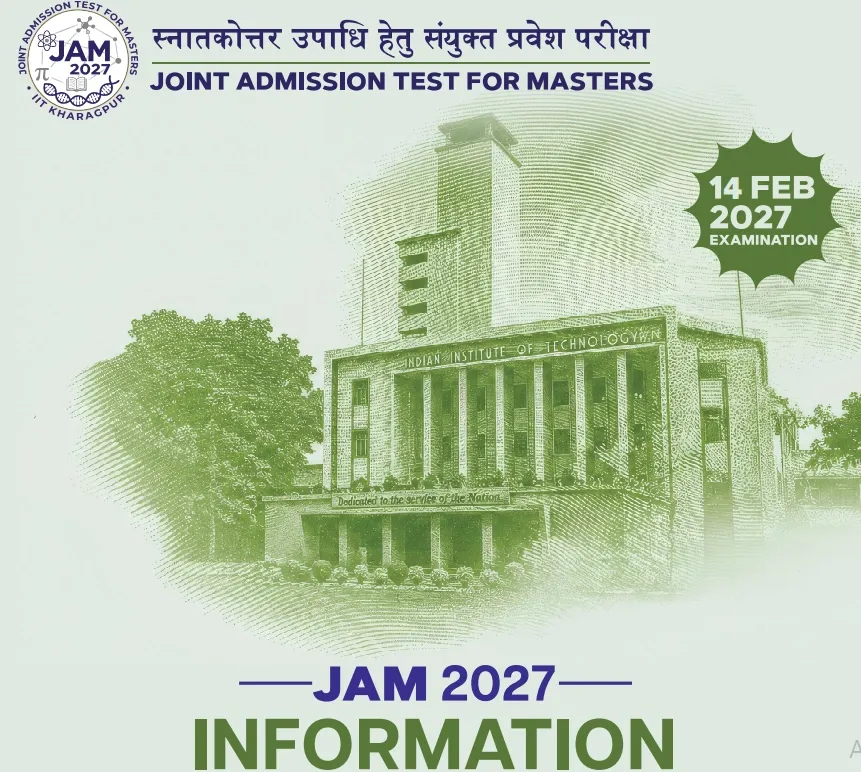
The JAM 2027 Chemistry paper is scheduled for the Forenoon session from 9:30 AM to 12:30 PM on February 14, 2027. Chemistry is one of the three test papers scheduled in the Forenoon session.
For the complete question distribution, marks and marking rules, refer to IIT JAM 2027 Exam Pattern: Question Types & Marking Scheme.
IIT JAM Chemistry Syllabus PDF Download
The IIT JAM Chemistry syllabus PDF covers the major areas of Chemistry that candidates need to prepare for the CY paper. The official JAM 2027 syllabus should be used as the primary reference when planning preparation.
Candidates can broadly organise their Chemistry preparation into:
Physical Chemistry
Important areas include:
- Basic mathematical concepts
- Atomic and molecular structure
- Chemical thermodynamics
- Chemical and phase equilibria
- Electrochemistry
- Chemical kinetics
- Solid state
- Solutions and colligative properties
- Spectroscopy and related concepts
Organic Chemistry
Preparation should cover areas such as:
- Basic organic chemistry
- Structure and bonding
- Stereochemistry
- Reaction mechanisms
- Hydrocarbons
- Haloalkanes and haloarenes
- Alcohols and phenols
- Aldehydes and ketones
- Carboxylic acids and derivatives
- Amines
- Aromatic compounds
- Biomolecules and related organic compounds
Inorganic Chemistry
Candidates should give attention to:
- Periodic properties
- Chemical bonding
- Coordination chemistry
- Main-group chemistry
- Transition elements
- Organometallic chemistry
- Qualitative aspects of inorganic chemistry
For the complete syllabus and detailed topic coverage, refer to IIT JAM Syllabus 2027: Subject-Wise Topics & Important Chapters.
Also Read:
- IIT JAM 2027 – Complete Guide to Exam, Syllabus, Eligibility, Application & Admission
- What is IIT JAM? Courses, Colleges & Career Scope
- IIT JAM Preparation Strategy 2027: Exam Pattern, Study Plan & Tips
- IIT JAM Syllabus 2027: Subject-Wise Topics & Important Chapters
- IIT JAM 2027 Eligibility Criteria: Qualification, Age Limit, Marks & More
- IIT JAM 2027 Application Process: Registration Dates, JOAPS Form Filling & Fees
Download CC Learning App and Start Preparing for IIT JAM 2027 Preparation with Expert Faculty Support!
Download Now!
Start Your IIT JAM Chemistry Preparation 2027
Solving IIT JAM Chemistry previous year question papers can show you which areas need more revision, but improving your score also requires consistent concept learning, practice and test analysis. For aspirants preparing for the IIT JAM 2027 Chemistry exam, a structured study plan can make it easier to balance Physical, Organic and Inorganic Chemistry.
With the CC Learning App, a multi learning platform, students looking for IIT JAM online coaching can access IIT JAM-focused classes, practice resources, previous year question support and mock tests in one place. The course is designed to help aspirants strengthen concepts, improve problem-solving skills and prepare systematically for the JAM exam.
If you are looking for structured IIT JAM coaching or convenient JAM coaching online for Chemistry, start your IIT JAM 2027 preparation with CC Learning App today.
IIT JAM Chemistry Previous Year Question Papers FAQs
Where can I download IIT JAM Chemistry previous year question papers?
You can download IIT JAM Chemistry previous year question papers directly from the link given in this article or from the official JAM website. The Downloads section provides year-wise question papers and answer keys.
How many years of IIT JAM Chemistry PYQs should I solve?
Candidates should solve as many official papers as are available and useful for their preparation. More importantly, analyse every paper and revise the concepts behind incorrect answers.
What are the main areas in IIT JAM Chemistry Exam 2027?
The IIT JAM Chemistry paper broadly covers Physical Chemistry, Organic Chemistry and Inorganic Chemistry. Candidates should follow the complete official JAM 2027 Chemistry syllabus rather than preparing only selected chapters.
What are the question types in IIT JAM Chemistry?
The JAM 2027 Chemistry paper contains MCQ, MSQ and NAT sections. MCQs have negative marking for incorrect answers, whereas MSQs and NAT questions do not have negative marking.
Is IIT JAM Chemistry difficult?
The IIT JAM Chemistry difficulty depends on the candidate's conceptual understanding, numerical ability and familiarity with the syllabus. Regular PYQ practice can help candidates understand the expected level and improve their approach to different types of Chemistry questions.
Is IIT JAM Chemistry conducted online?
Yes. IIT JAM 2027 is conducted as a Computer-Based Test (CBT). Chemistry is scheduled for the Forenoon session on February 14, 2027.
Is IIT JAM Chemistry coaching necessary?
IIT JAM Coaching is not compulsory. Students who can follow the syllabus and maintain a consistent self-study routine can prepare independently. However, IIT JAM online coaching can be useful for candidates who want structured classes, guidance, practice resources and mock tests.
Notifications
Trending Updates


Related Blogs
September 1, 2026
IIT JAM 2027 – Complete Guide to Exam, Syllabus, Eligibility, Application & Admission
16 minute read
September 2, 2026
IIT JAM 2027 Eligibility Criteria: Qualification, Age Limit, Marks & More
10 minute read
September 2, 2026
IIT JAM 2027 Application Process: Registration Dates, JOAPS Form Filling & Fees
6 minute read
September 3, 2026