
Table of Contents
High Court Assistant Previous Year Question Papers are among the most valuable preparation resources for candidates preparing for Kerala High Court Assistant Recruitment 2026. Solving previous year papers helps candidates understand the actual exam pattern, question difficulty level, subject-wise weightage, descriptive paper requirements, and frequently repeated topics.
Candidates preparing for the upcoming High Court Assistant exam 2026 should regularly practise previous year question papers along with mock tests, syllabus coverage, and revision. Analysing earlier papers helps improve time management, accuracy, confidence, and overall exam readiness.
High Court Assistant Previous Year Question Papers Overview
High Court Assistant previous year question papers provide candidates with first-hand exposure to the actual exam pattern followed by the Kerala High Court. Regular practice enables aspirants to identify important topics, improve question-solving techniques, and become familiar with both the Objective Test and Descriptive Test.
Particulars | Details |
Recruitment Authority | High Court of Kerala |
Post Name | High Court Assistant 2026 |
High Court Assistant Selection Process | Objective Test, Descriptive Test & Interview |
High Court Assistant Objective Test Questions | 100 Questions |
High Court Assistant Objective Test Marks | 100 Marks |
High Court Assistant Descriptive Test Marks | 60 Marks |
High Court Assistant 2026 Negative Marking | 0.25 Mark Deduction for Each Wrong Answer |
High Court Assistant 2026 Medium of Exam | English |
High Court Assistant 2026 Question Standard | Bachelor's Degree Level |
High Court Assistant Best Preparation Resource | High Court Assistant Previous Year Question Papers & Mock Tests |
High Court Assistant Official Website Link |
Download High Court Assistant Previous Year Question Papers PDF
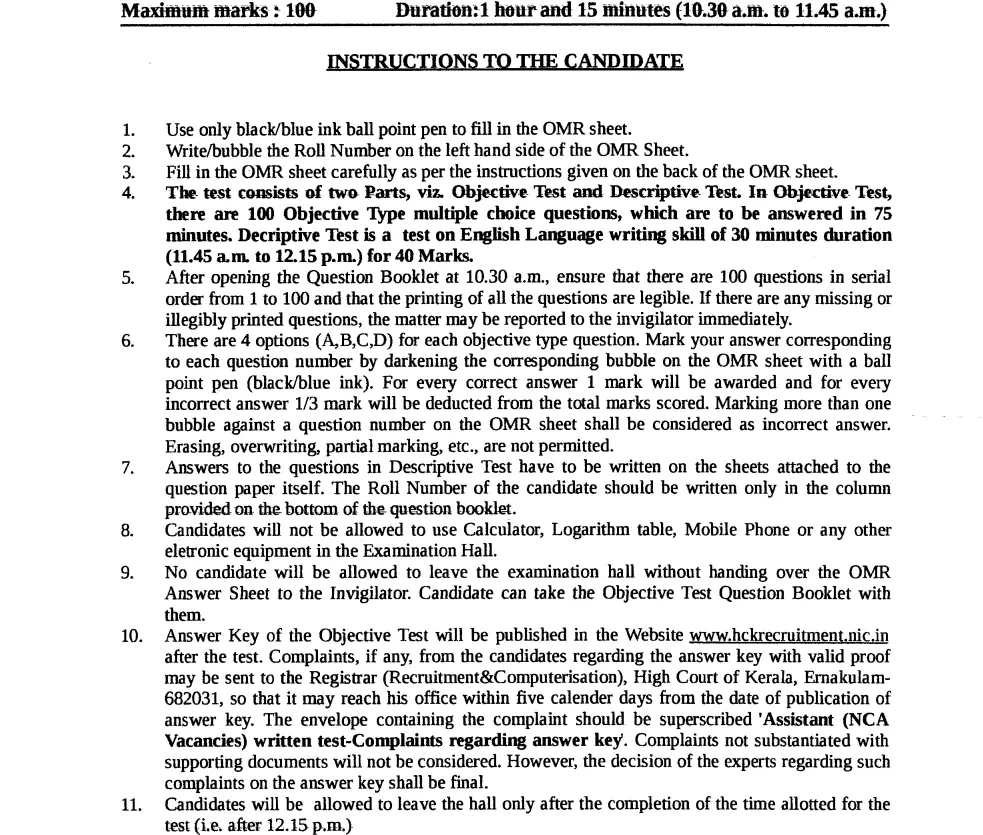
Candidates can download High Court Assistant Previous Year Question Papers PDF from the links provided below.
High Court Assistant PYQs Yearwise | Question Paper PDF |
High Court Assistant Previous Year Question Paper 2024 - Objective Test | |
High Court Assistant Previous Year Question Paper 2024 - Descriptive Test | |
High Court Assistant Previous Year Question Paper 2022 - Objective Test | |
High Court Assistant Previous Year Question Paper 2022 - Descriptive Test | |
High Court Assistant Previous Year Question Paper 2020 - Objective Test | |
High Court Assistant Previous Year Question Paper 2020 - Descriptive Test | |
High Court Assistant Previous Year Question Paper 2019 - Objective Test | |
High Court Assistant Previous Year Question Paper 2019 - Descriptive Test | |
High Court Assistant Previous Year Question Paper 2016 - Objective Test | |
High Court Assistant Previous Year Question Paper 2016 - Descriptive Test | |
High Court Assistant Previous Year Question Paper 2014 - Objective Test | |
High Court Assistant Previous Year Question Paper 2014 - Descriptive Test |
Kerala High Court Assistant Model Questions - Objective Test
Practising Kerala High Court Assistant model questions is an effective way to understand the exam pattern, question standard, and important topics frequently tested in the Objective Test. Since the exam includes General English, General Knowledge, Basic Mathematics, and Reasoning, solving practice questions helps candidates improve accuracy, speed, and confidence. The sample questions below are designed to reflect the difficulty level and style commonly expected in the Kerala High Court Assistant Objective Test.
1. PM SVA Nidhi Scheme of the Government of India is meant for:
A) School children of tribal villages
B) Women entrepreneurs of villages
C) Street Vendors
D) Swachh Bharat workers
Answer: C) Street Vendors
2. Rani Ki Vav, the UNESCO Heritage Site in Gujarat, was built by Queen Udayamati in memory of:
A) King Bhima I
B) King Bhima II
C) King Mulraj I
D) King Jaysinh I
Answer: A) King Bhima I
3. Which Article of the Constitution mentions the functions of the Union Public Service Commission (UPSC)?
A) Article 315
B) Article 323
C) Article 316
D) Article 320
Answer: D) Article 320
4. A type of phishing attack that targets a specific individual, group, or organisation is called:
A) HTTPS Phishing
B) Clone Phishing
C) Angler Phishing
D) Spear Phishing
Answer: D) Spear Phishing
5. Which among the following is called "Philosopher's Wool"?
A) Zinc Bromide
B) Zinc Nitrate
C) Zinc Oxide
D) Zinc Chloride
Answer: C) Zinc Oxide
6. The bank in India that issued the first green bond for financing renewable energy projects is:
A) ICICI Bank
B) SBI
C) Yes Bank
D) Kotak Mahindra Bank
Answer: C) Yes Bank
7. In the legal expression "save as otherwise prescribed", the word "save" means:
A) Excuse
B) Extract
C) Except
D) Expose
Answer: C) Except
8. The phrase meaning "let the buyer beware" is:
A) Quid pro quo
B) Caveat emptor
C) Pari passu
D) Quo vadis
Answer: B) Caveat emptor
9. The intense fear of the number 13 is called:
A) Cleithrophobia
B) Claustrophobia
C) Triskaidekaphobia
D) Alaktrophobia
Answer: C) Triskaidekaphobia
10. A polyglot is:
A) A man who has two wives
B) A person who can speak many languages
C) A person who has mastered arithmetic skills
D) A man who can drive multiple vehicles
Answer: B) A person who can speak many languages
Kerala High Court Assistant Model Questions - Descriptive Test
The Kerala High Court Assistant Descriptive Test evaluates a candidate's ability to communicate effectively in written English, which is an essential skill for court administration and official correspondence. The descriptive paper generally assesses comprehension, précis writing, summarisation, analytical thinking, and essay-writing ability. Candidates preparing for the Kerala High Court Assistant Exam 2026 should practise descriptive writing regularly to strengthen their performance in this important stage of the selection process.
Reading Comprehension
1. Read the following passage and answer the questions given below in no more than thrcc sentenccs cach. (10 x 2 = 20 Marks)
Violence against women affects the ability of women to achieve full functioning in the world. I define violence against women as physical, sexual, and emotional violence against women and girls by intimates, acquaintances, or strangers. Like many researchers, I view it as a patriarchal mechanism for controlling women, defined particularly by the use of power, force, manipulation, and isolation. Women who have been victimized by an intimate partner or a stranger often experience fear, shame, and isolation. People who abuse women may use the tactic of isolation by deliberately isolating them from friends, family, work, and social institutions. These abusers often perceive connections with others in the community as a threat to their system of power and control. Women tend to be cut off from law enforcement, courts, healthcare systems, and other sources of social support. According to Sullivan, it has been suggested that a critical reason so many women remain with or return to their assailants is a lack of access to community resources; specifically, housing, legal assistance, employment, education, finances, childcare and social support systems. This isolation from such social support is so pervasive that the most common form of intervention with survivors of violence is advocacy services. The purpose of such advocacy services is to enhance the quality of women's lives by improving their access to community resources and increasing the social support available to them. Furthermore, because of the nature of the isolation associated with a problem such as violence against women and the fact that it is understood as a community rather than individual problem, many communities have developed community response teams to violence consisting of representatives of various institutions in the community. Women who have been assaulted or battered may be dealing with the realities of Post-Traumatic Stress Disorder (PTSD), anxiety, depression, and other physical health problems. Tolman and Rosen found that women who experienced domestic violence in the past year reported three times as many mental health disorders as their non-abused counterparts. Sullivan and Bybee found that when abuse in an intimate relationship ceased, the victim's physical health improved. Nasir and Hyder identified domestic violence among pregnant women in developing countries as a significant global health issue. The main risk factors in their research were identified as belonging to a low-income group, litle education in both partners, and unplanned pregnancy. Many survivors of violence must cope with memories of traumatic events, thoughts of suicide, and the effects of physical injuries. The ongoing effects of violence-physical and emotional-can be barriers to women's ability to engage in the community, get vocational training and education, and work in both formal and informal sectors.
- What are the ordeals experienced by women who have been victimized by an intimate partner or a stranger?
- What are the findings of Tolman and Rosen and Sullivan and Bybee regarding violence against women?
- Why do women stay back with their attackers even after undergoing too much domestic violence?
- What are the harsh realities assaulted women deal with in life?
- How is violence explained in the passage?
- What is an advocacy service?
- What are the reasons associated with the violence against pregnant women
- What is the tactic used by people who abuse women? Why?
- How have the communities reacted to violence against women?
- What is the central argument of this passage?
Short Essays
2. Write short essays (150 words each) on any two of the following topics:
(2 x 15 = 30 Marks)
- The practical use of Artificial Intelligence in jurisprudence.
- Your personal experience of climate change over the past decade.
- Global impact on economic sanctions.
Precis Writing
3. Read the following passage and write a precis of the content, reducing it to around one-third of its length. (1× 10 = 10 Marks)
People today are much cleverer than they were in previous generations. A study of 12 countries found that average IQs rose by 2.2 points a decade between 1948 and 2020. This stunning change is known as the "Flynn effect" after James Flynn, the scientist who first noticed it. Flynn was initially baffled by his discovery. It took millions of years for the brain to evolve. How could it improve so rapidly over just a few decades? The answer is largely that people were becoming better nourished and mentally stimulated. Just as muscles need food and exercise to grow strong, so the brain needs the right nutrients and activity to develop. Kids today are much less likely to be malnourished than they were in past decades, and more likely to go to school. Yet there is no room for complacency. Young minds today are being squandered in two ways. In rich countries, the Flynn effect has largely run its course and educational attainment there has levelled off. By far the graver problem, however, is that in poor and middle-income countries, many children are still too ill-fed to reach their cognitive potential. Globally, 22% of under-fives -roughly 150m children-are malnourished to the point of stunting. That means their brains are likely to be stunted, too. Half the world's children suffer micronutrient deficiency, which can also impede brain development. Poor nutrition and a lack of stimulation can translate into a loss of as many as 15 IQ points. This has woeful consequences: one study found stunting led to incomes being 25% lower. Damage incurred during the golden window" of the first 1,000 days after conception is likely to be permanent. Some argue that human intelligence will matter less as people outsource their thinking to artificial intelligence. To assume this would be as foolish as betting 100 years ago that the invention of the car would make it unnecessary to walk. In the workplace, human intelligence and Al will probably complement each other. And brains are for the joy of thinking, as well as earning money. Steven Pinker of Harvard University calls intelligence a tailwind in life", helping people adapt rationally to new challenges or a changing environment. For the modest price of a simple, balanced diet, the next generation can have a stronger tailwind. It would not only be wrong to refuse them. It would be stupid.
Read More at:
- High Court Assistant Vacancy 2026: Expected Vacancies, Previous Trends & Recruitment Updates
- High Court Assistant Exam Pattern 2026: Objective Test, Descriptive Test & Interview
- Kerala High Court Assistant Syllabus & Exam Pattern 2026
- Kerala High Court Assistant 2026 – Notification, Exam Date, Eligibility & Preparation Guide
- Kerala High Court Assistant Notification 2026
- Kerala High Court Assistant Eligibility Criteria 2026 : Age Limit & Qualification
- Kerala High Court Assistant Salary 2026 – In Hand Salary, Pay Scale & Allowances
- Kerala High Court Assistant 2026 Study Plan: Subject-Wise Preparation Guide
Download CC Learning App today and strengthen your High Court Assistant preparation with expert mentorship and exam-focused learning resources!
Join Now!
Practise High Court Assistant Questions with Expert Guidance
High Court Assistant Previous Year Question Papers provide an excellent starting point, but consistent practice and expert guidance are equally important for securing a top rank. Candidates should complement previous paper practice with organised learning, mock tests, current affairs preparation, descriptive writing sessions, and regular revision.
CC Learning App by Competitive Cracker provides the best preparation support for Kerala High Court Assistant 2026, Kerala PSC, SSC, Banking, Teaching, Railways, and other competitive examinations through expert-led classes, mock tests, PYQ discussions, descriptive writing practice, current affairs updates, and personalised study plans.
Download CC Learning App today and strengthen your High Court Assistant preparation with expert mentorship and exam-focused learning resources.
Frequently Asked Questions for High Court Assistant 2026
Where can I download the High Court Assistant Previous Year Question Papers PDF?
Candidates can download previous year papers from the links provided above and official recruitment resources whenever available.
Are previous year question papers enough for High Court Assistant preparation?
No. Previous papers should be used along with syllabus coverage, mock tests, revision, and descriptive writing practice.
Does Kerala High Court repeat questions from previous papers?
Exact questions may not repeat frequently, but topic patterns and question styles often remain similar.
How many High Court Assistant previous year papers should I practise?
Candidates should attempt as many available papers as possible, preferably covering multiple recruitment cycles.
Do High Court Assistant previous year papers help in descriptive test preparation?
Yes. High Court Assistant previous papers provide insights into the type of precis, comprehension, and essay topics that may be asked.
Is there negative marking in the High Court Assistant Objective Test?
Yes. One-fourth mark is deducted for every incorrect answer in High Court Assistant Objective Test.
What is the best way to analyse High Court Assistant previous year papers?
Review incorrect answers, identify weak areas, revise relevant topics, and reattempt papers after revision.
Notifications
Trending Updates


Related Blogs
June 4, 2026
High Court Assistant Exam Pattern 2026: Objective Test, Descriptive Test & Interview
7 minute read
June 4, 2026
High Court Assistant Vacancy 2026: Expected Vacancies, Previous Trends & Recruitment Updates
4 minute read
April 4, 2026