
Table of Contents
If you're planning to study abroad, crack language exams, or build a global career, learning the German alphabet is your first and most important step.
German is one of the most in-demand languages in Europe, and thousands of students are now actively learning it for higher education, international job opportunities and immigration pathways.
Without a clear understanding of the alphabets in German language and correct pronunciation, your German learning journey will become slow, confusing and frustrating.
This article will help you learn faster, pronounce correctly and avoid beginner mistakes.
What is the German Alphabet?
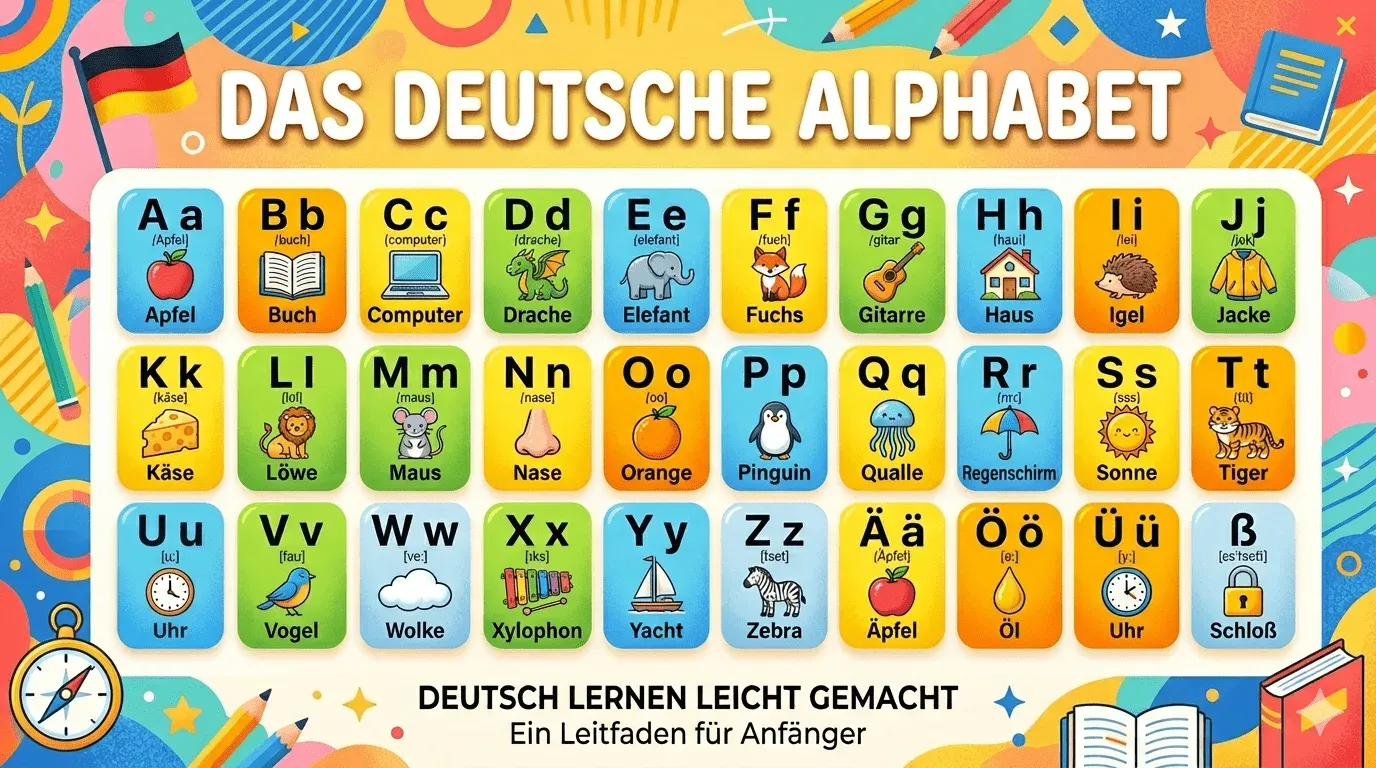
The German alphabet, based on the Latin script similar to the English alphabet, consists of 26 standard letters (A - Z), three umlaut vowels (Ä, Ö, Ü) and one special character (ß – Eszett or sharp S), making a total of 30 characters essential for mastering German language basics and pronunciation.
Join Today For The Best German Language Coaching Class
Enrol Now
German Alphabet A to Z with Pronunciation
Here’s the complete German alphabet chart with easy pronunciation:
Letter | Pronunciation | Sound Tip |
A a | ah | like “a” in father |
B b | bay | soft “b” |
C c | tsay | mostly “ts” |
D d | day | similar to English |
E e | ay | like “a” in say |
F f | eff | same as English |
G g | gay | hard “g” |
H h | hah | breathy sound |
I i | eeh | like “ee” |
J j | yot | sounds like “y” |
K k | kah | strong “k” |
L l | ell | clear “l” |
M m | em | same |
N n | en | same |
O o | oh | rounded “o” |
P p | pay | strong “p” |
Q q | koo | used with “u” |
R r | air | rolled/throaty |
S s | es | sometimes “z” |
T t | tay | crisp “t” |
U u | ooh | like “oo” |
V v | fau | sounds like “f” |
W w | vay | sounds like “v” |
X x | iks | “ks” |
Y y | üpsilon | rare |
Z z | tset | “ts” sound |
Special Characters in German
Umlauts (Ä, Ö & Ü)
Umlauts are vowels with two dots above them. They change the sound completely.
Letter | Sound | Example |
Ä ä | like “e” in “bed” | Mädchen |
Ö ö | rounded “e” | schön |
Ü ü | tight “u” sound | über |
Umlauts are essential for correct pronunciation and meaning.
ß (Eszett / Sharp S)
- Pronounced like “ss”
- Used after long vowels or diphthongs
- Example: Straße (street)
This letter does not exist in English, making it unique to German.
Key Differences Between German & English Alphabet
Understanding these differences will improve your German fluency quickly:
1. W and V are swapped
- W - sounds like V
- V - sounds like F
Example:
- Wasser = Vasser
- Vater = Fater”
2. J sounds like Y
- Ja = Ya
3. Z always sounds like “TS”
- Zeit = Tseit
4. All Nouns are Capitalised - This is a major German grammar rule.
Example : der Mann (the man)
Why Learning the German Alphabet is Important for Beginners?
Understanding the alphabets in the German language is the foundation of studying the German language. When you learn the German alphabet A to Z with correct pronunciation, you automatically.
- Read German words correctly
- Improve pronunciation instantly (Speaking clarity)
- Build strong language basics
- Avoid common beginner mistakes
- Learn faster than others
Many beginners struggle in German because they ignore pronunciation rules at the start. But if you build a strong base with the German letters and sounds, everything becomes easier.
Easy Tricks to Master the German Alphabet Fast
If you want to learn the German alphabet quickly and effectively, these proven strategies will help you improve faster and build a strong foundation in German pronunciation.
1. Learn with Sound Associations
Connect each German letter with a familiar English sound. This technique boosts memory retention and makes recall much easier.
2. Practice with Real Words
Avoid memorising letters in isolation. Instead, learn them with commonly used German words:
- A - Apfel (apple)
- B - Ball
- D - Danke (thank you)
This method helps you understand both pronunciation and vocabulary at the same time.
3. Focus on Daily Pronunciation Practice
Spend at least 10 - 15 minutes every day practicing pronunciation. Consistency is the key to mastering the German alphabet quickly.
4. Use Audio & Listening Exercises
Listening to native speakers improves your ability to recognise authentic German sounds. Use audio tools, apps or videos for better results.
5. Revise Umlauts (ä, ö, ü) and ß Regularly
Umlauts and the letter ß (Eszett) are essential in German. Regular revision helps avoid confusion and ensures accurate pronunciation.
Learn German Easily with CC Learning App
Ready to start learning German? Choose a course that keeps things simple and clear.
CC Learning App offers beginner-friendly German classes, starting from A1 level and moving step by step to higher levels like A2 and B1.
What You Get:
- Live and recorded app based classes
- Simple, easy-to-follow lessons
- Expert trainers
- Step by step learning
- Great for study abroad and career growth
Start your German journey today with CC Learning App and learn with confidence.
Download CC Learning App Now & Start Learning German Language
Tap Here
Frequently Asked Questions
1. What is the German alphabet?
The German alphabet is based on the English alphabet and has 26 letters (A–Z) plus 4 extra characters (Ä, Ö, Ü, ß). These are important for correct pronunciation and meaning.
2. How many letters are in the German alphabet?
There are 30 letters in total, 26 standard letters, 3 umlauts and 1 special letter (ß).
3. Is the German alphabet easy to learn for beginners?
Yes, the German alphabet is easy to learn because it is similar to English. With regular practice, beginners can understand it quickly.
4. What are umlauts in German?
Umlauts (Ä, Ö, Ü) are special vowels in German. They change the sound of the word and are very important for correct pronunciation.
5. What is ß in the German language?
The letter ß (Eszett) sounds like “ss”. It is used in specific words like Straße (street) and is unique to German.
6. Is German useful for study abroad and jobs?
Yes, German is one of the most in-demand languages in Europe, especially for higher education, jobs, and migration opportunities.
Trending Updates